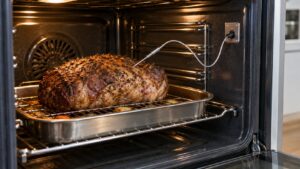
What C-20 means on your Dacor oven (dacor oven c-20)
Dacor oven c-20 is the Samsung-era Modernist wall oven’s primary cavity-sensor failure: while the oven is actively heating, the main PBA has read the oven sensor circuit as either open or shorted, meaning it can no longer trust the reported cavity temperature. This is the closest Samsung-era equivalent to the Legacy Dacor F3/F4 sensor failures, but on one combined code rather than two separate short/open codes. Because the problem occurs mid-operation rather than at startup, the oven halts heating rather than continuing on an unverified reading.
Symptoms
The signs below separate this condition on your Dacor oven from other problems that present almost identically on an oven.
- C-20 appears mid-cycle, typically after the oven has already been heating for some time.
- The oven stops heating and the current cook or bake cycle cannot continue.
- Displayed temperature may freeze or jump erratically just before c-20 appears.
- The problem can recur every time a cycle reaches a similar point in the bake.
- There is no unusual smell or noise, since this is purely a sensor-reading problem.
Common causes
More than one thing can produce C-20 on an oven, so the causes below are ordered by how often they turn out to be responsible on a Dacor oven.
- Failed oven temperature sensor — the sensor element has shorted or opened, often after years of high-heat cycling.
- Damaged sensor wiring — a wire chafed against a hot surface inside the cavity liner can short or break.
- Loose sensor connector — a connection point behind the cavity has partially disconnected from vibration or thermal movement.
- Corrosion at the sensor plug — moisture exposure over time raises resistance until the reading is unreliable.
- Main PBA sensor-input problem — less commonly, the board’s own sensing circuit is misreading a healthy sensor.
Troubleshooting steps you can try
These checks cost you nothing on an oven and often end the problem there; anything harder on a Dacor oven needs a technician.
- Power-cycle the oven at the breaker and try a shorter, lower-temperature cook to see if c-20 recurs quickly.
- Note approximately how long into a cycle the problem tends to appear, since a consistent pattern points more strongly at heat-related wire fatigue.
- Avoid running long, high-temperature cycles like roasting or self-clean until the sensor is confirmed good.
- Do not attempt to access or test the cavity sensor wiring yourself — it is behind the liner.
- Have your model and serial number ready so the correct sensor part can be matched before the technician visit.
Parts a technician may replace
Expect the oven temperature sensor, sensor wiring harness, and main pba to be checked on your Dacor oven. Replacing more of an oven than the problem requires is how a small oven repair becomes an expensive one, so the failed part is confirmed first.
When to call a technician
C-20 is rated High severity because the oven cannot verify cavity temperature once it fires, so book a technician rather than continuing to run cook cycles that keep cutting short. This is High severity, so the oven should come out of service until a technician has seen it rather than being run again. Your oven is repaired by an independent third party, not by the manufacturer, with 30 days of cover on our labor.
Related help and Dacor resources
If the checks above did not clear the C-20 condition, book a technician for the oven. Our oven problem index covers the neighboring problems, and www.dacor.com carries the oven spec.