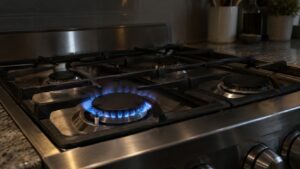
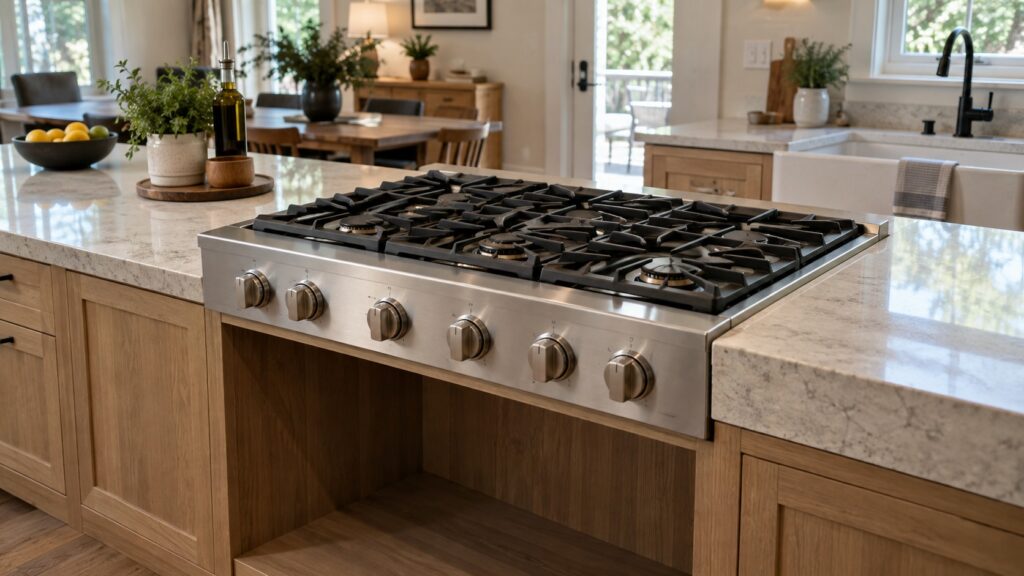
Deciding on Dacor rangetop repair or replace starts with understanding what a rangetop actually is: a cooktop-only unit built into a run of cabinetry with no oven underneath — the 36-inch DTT36 models and the 48-inch DTT48 sit on top of standard base cabinets rather than a self-contained range body, which changes how a repair-or-replace decision plays out compared to a range or wall oven. There is no oven cavity, no self-clean cycle, and no oven control board to fail alongside the burners, so the list of things that actually go wrong on a rangetop is shorter and more mechanical than on a full range, which usually tips the repair side of the decision in the rangetop’s favor.
What actually breaks on a Dacor rangetop?
Because a rangetop has no oven cavity, everything that can fail lives at or just below the cooking surface: burner valves that control gas flow, igniters that spark the burner, the grates and caps that sit on top, and on some models a control module that manages simmer settings or communicates burner status. A single burner failing to light, failing to hold a low simmer, or clicking without lighting is by far the most common complaint, and almost always traces to one igniter or one valve rather than a system-wide fault. Compare that to a full range, where the same complaint could also involve a shared control board serving both the cooktop and an oven — a rangetop simply has fewer shared components that can take down more than one burner at once.
When does a repair make more sense than replacing the unit?
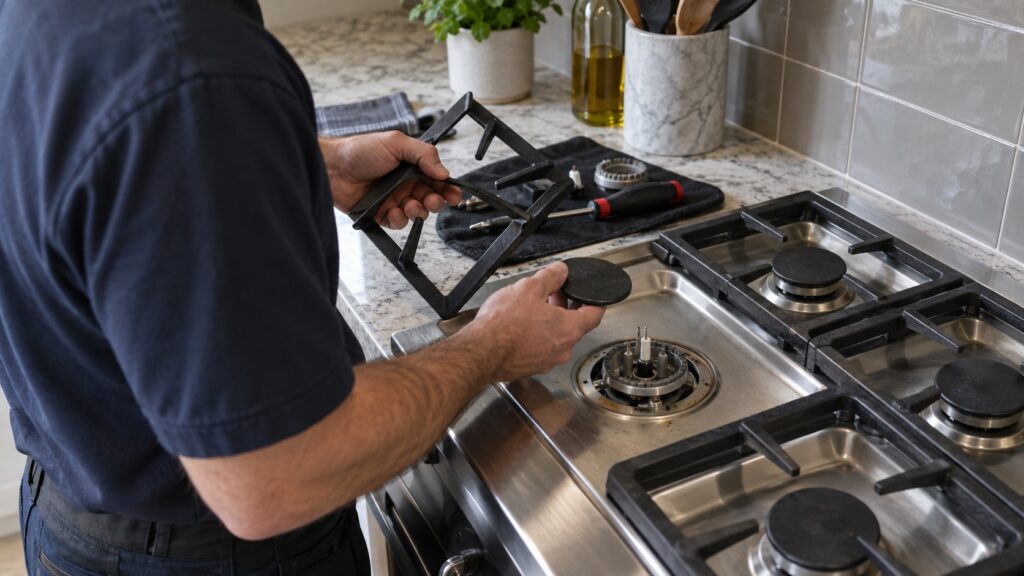
Almost always, if the fault is limited to one or two burners and the cooktop surface itself is intact. An igniter, a burner valve, or a set of grates are inexpensive, commonly available parts relative to the cost of a new rangetop, and replacing one does not require pulling the whole unit out of the countertop cutout. The same logic applies to a control module failure on models that have one — it is a component swap, not a reason to replace a unit whose burners and surface are otherwise sound. Read our Dacor rangetop maintenance guide for the upkeep that keeps burners lighting reliably and can head off some of these failures before they need a part.
When does replacement start making more sense?
Replacement becomes the better call when the damage is to the cooktop surface itself rather than to a single component — a cracked or heavily warped deck, corrosion that has spread across multiple burner bases, or a unit where three or more burners have failed independently over a short span, which points at an aging or degraded shared system rather than one bad part. A rangetop nearing the end of a long service life that needs its second or third control module in a few years is also a candidate for replacement, since repeated failures of the same component are a sign the underlying electronics are wearing out, not that each replacement was simply unlucky.
Does the rangetop’s age change the calculation?
Yes, in a fairly direct way: parts availability and the cost of a repair relative to a new unit both shift as a model ages. A rangetop in its first several years usually has parts readily available and a repair cost that is a small fraction of replacement. An older model, especially one from a discontinued platform, can face longer waits or higher costs for the same parts, and at that point a repair that would have been an easy call on a newer unit becomes a closer decision. Checking parts availability for the specific model before committing to either path avoids starting a repair only to find the part is backordered for weeks.
How does swapping in a replacement rangetop actually work?
A replacement has to match the existing cutout width — a 36-inch DTT36 opening needs a 36-inch replacement, and a 48-inch DTT48 opening needs a 48-inch replacement — because resizing a countertop cutout is a much bigger job than swapping the appliance itself. Beyond width, confirm the fuel type and the ventilation setup match: a gas rangetop replaced with an electric or induction model changes both the gas line behind it and the ventilation needs above or below it, which is a bigger project than a straight swap. See our Dacor rangetop buying guide for how the two sizes and fuel types compare if replacement turns out to be the right call.
Does the rangetop’s own service history change the decision?
A rangetop that has needed one igniter or one valve replaced over several years of use is behaving normally — mechanical parts at the burner level wear gradually and get replaced individually as they go, and that pattern by itself says nothing about the unit’s remaining life. A rangetop that needs the same burner repaired twice within a short span, or where a control-module replacement is followed by another module failure within a year or two, is a different pattern: it points toward a shared component that is degrading rather than isolated wear, and that history matters more to the repair-or-replace decision than the unit’s age in years alone.
What should you check before deciding either way?
Confirm how many burners are actually affected, whether the cooktop surface itself is damaged, and whether this is the unit’s first significant repair or its third. A single burner with an igniter or valve problem, on an otherwise sound surface, is a straightforward repair almost every time. Multiple independent failures, surface damage, or a unit that keeps needing the same part replaced point toward replacement instead. If you are unsure which category your rangetop falls into, our technicians can make that call after a proper diagnosis rather than a guess based on symptoms alone.
We are an independent repair company, not a factory service arm, and we will tell you when a repair is not worth doing rather than sell one anyway. Pricing starts from a diagnostic visit and we confirm the estimate before any work begins. Schedule Dacor rangetop repair or book a visit with the burner and symptom details ready.