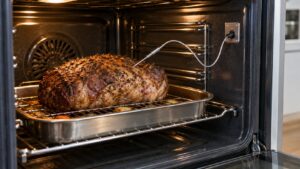
What C-23 means on your Dacor oven (dacor oven c-23)
Dacor oven c-23 refers specifically to the plug-in temperature probe some Modernist wall ovens accept for monitoring food temperature during a cook, not the cavity sensor covered by c-20. The main PBA has detected a short on the probe circuit while a cycle using the probe was active. Because this affects only the probe-monitoring feature and not the oven’s own cavity sensing or heating safety, Dacor’s manual treats it as a lower-impact problem than the cavity-sensor codes, and in many cases an owner can resolve it without a service call.

Symptoms
Check the oven against each of these before concluding anything: C-23 on a Dacor oven looks a lot like several cheaper problems.
- C-23 appears only during a cycle where the food temperature probe is plugged in and in use.
- The probe reading on the display may freeze, jump erratically, or read implausibly hot or cold just before the problem.
- The oven itself continues heating normally, since cavity temperature control is unaffected.
- The problem can appear if the probe cable is pinched by the oven door when it closes.
- Unplugging the probe and continuing without it typically clears the problem immediately.
Common causes
What produces C-23 on a Dacor oven is not always the component people assume, which is why the oven causes below run from most to least likely.
- Probe cable pinched in the door — closing the door on the cable can short the fine wires inside.
- Damaged probe tip or cable insulation — repeated use and cleaning can wear through the probe’s outer sheath.
- Faulty probe jack — the socket the probe plugs into inside the cavity has corroded or loosened.
- Moisture on the probe connector — condensation or food residue at the plug can bridge the contacts.
- Worn probe from age — the probe itself, being a low-cost accessory part, simply wears out over repeated use.
Troubleshooting steps you can try
These checks cost you nothing on an oven and often end the problem there; anything harder on a Dacor oven needs a technician.
- Unplug the probe from its jack and continue the cook cycle without it if a probe reading is not essential.
- Inspect the probe cable for visible pinching, cracking, or exposed wire, especially near the door seal.
- Wipe the probe connector and jack dry before reinserting, in case moisture is bridging the contacts.
- Try a different probe if you own a spare, to isolate whether the probe or the jack is responsible.
- Route the probe cable so the door does not close directly on it in future cycles.
Parts a technician may replace
The meat probe temperature sensor, probe jack, and main pba are what a technician examines on an oven showing this problem. Genuine parts are fitted to the oven, matched to your exact oven rather than to the family it belongs to.
When to call a technician
If a known-good probe still trips c-23, the probe jack inside the cavity likely needs replacing, which is a quick technician job rather than a major repair. There is no urgency at Medium severity, yet an oven that repeats C-23 after these checks deserves a technician’s eyes. We hold no affiliation with the manufacturer of your oven; the parts are genuine and the labor is warranted for 30 days.
Related help and Dacor resources
Where the C-23 condition persists on an oven, stop retrying and arrange service. See also our oven repair guides, our service areas, and www.dacor.com for the oven specification.