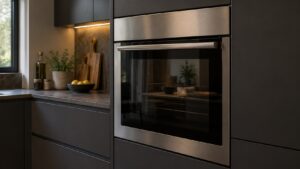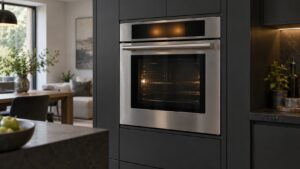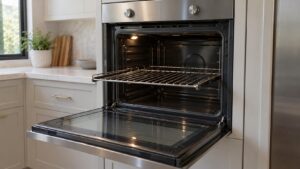
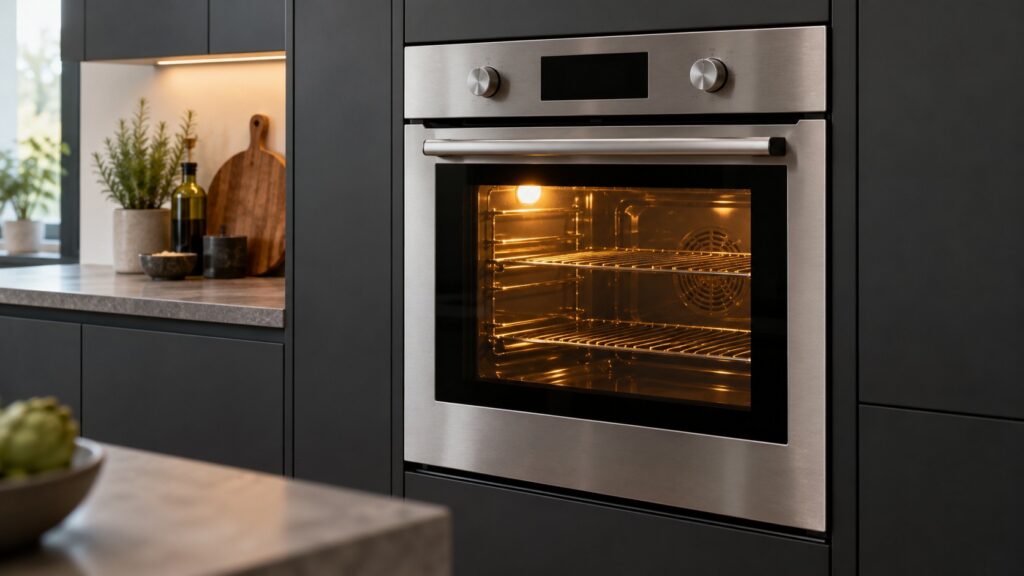
How Dacor convection oven works comes down to one part: a fan. A Dacor convection oven works by moving the oven’s hot air with a fan instead of letting it sit still. In a conventional oven the heat rises and settles in layers, so food browns more on one side or one rack than another. A fan stirs the air through the cavity, which is why convection cooking is usually more even and why a convection fan that stops is a real loss even when the oven still heats. Dacor markets its version as Four-Part Pure Convection, and the exact modes, timing advice and settings for your model are in the owner’s manual.
How does a Dacor convection oven cook food?
The heating elements make the heat; the fan spreads it. With the fan running, hot air moves past the food on every side instead of pooling at the top of the cavity, and the temperature across a rack levels out. That is the general way convection ovens are built, and Dacor’s Four-Part Pure Convection follows the same idea. Our pages describe it as splitting the convection system into four parts for what Dacor calls more even heat distribution, and the brand also describes reduced flavor transfer between dishes. We do not know from the site which part does which job, and what each part does on your exact model is in the owner’s manual.
The practical result for an owner is that baking on more than one rack, roasting and browning all benefit from moving air, while very delicate batters can behave differently. If a recipe says it assumes convection, it assumes the fan is running.
What is Dual Four-Part Pure Convection?
On the larger double-cavity ranges, such as the 48-inch DOP48M96DL, our range pages say the oven runs Dual Four-Part Pure Convection. That means one complete convection system per oven cavity rather than one system shared across both. It affects how evenly heat distributes across a larger range, and it means a problem in one cavity’s system will not necessarily show up in the other. Smaller single-cavity ranges run a single system. Our guide to how dual-fuel cooking works on a Dacor range shows how the electric convection oven pairs with gas burners on the same range.
Do wall ovens and ranges use the same convection system?
The idea is the same, but the model numbers and generations differ. Our oven pages list Samsung-era wall ovens such as the DOB30M977SM, a 30-inch single oven with steam, and the DOB30T977SS, a 30-inch single oven with no steam function. They also list the older Heritage HWO130FS. Which of them has which convection modes is not something our pages spell out, so treat the owner’s manual for your model number as the authority. The same applies to steam: a steam-equipped oven has a water path and extra parts, and a steam-assisted mode behaves differently from standard bake in timing.
If you are not sure which generation you own, our page on which generation of Dacor you have explains how to tell, and it decides which manual and which fault codes apply.
How can you tell the convection fan is working?
Select a convection setting and listen near the rear wall of the cavity, where the fan is mounted, for any sound at all. A working fan is audible. Warning signs are no sound during a convection cycle, a faint hum without any spinning, a fan that runs briefly at the start and then stops, or food that bakes as if it were in standard mode with less even browning. Our oven convection fan not running page lists these symptoms and explains that the usual cause is a worn or seized fan motor rather than the control board.
That page also lists the other candidates: a blade blocked by grease or a dislodged object, a failed fan relay, damaged wiring between the control board and the motor, or a motor thermal cutoff that tripped. All of those are behind the cavity wall, which makes the diagnosis a technician’s job. Do not remove the rear panel or the fan cover to look.
What keeps a convection oven working well?
Three habits, none requiring tools. Keep the door gasket clean, because a grease-caked seal lets heat escape and makes the oven seem underpowered. On models that have it, run the steam-based GreenClean cycle on light buildup rather than waiting for a heavy mess; our pages say it keeps residue from collecting around the door seal and the convection fan housing, which is a more common cause of uneven baking than a failing element. And listen to the fan from time to time: a change in the sound, or a fan that stops mid-cycle, is easier to deal with early. Our wall oven maintenance guide covers the routine.
While the fan is not working, do not run recipes written for convection as they stand, since their times and temperatures assume the airflow is present. Use standard bake and check the food earlier than you normally would; the timing is not something we can give you as a number.
When does a convection problem need a technician?
Book when the fan is silent in convection mode, stops during a cycle, hums without turning, or when one side of a rack keeps browning more than the other after you have cleaned the door seal and confirmed the mode. If a code shows on the display, note it, because the two Dacor generations use different code systems and the same code never means the same thing in both. If you smell burning or see sparks, switch off the oven’s breaker at the panel while standing on a dry floor and call. Our Dacor oven repair page explains what a visit covers.