
Dacor dishwasher F-5 is an air flow fan failure on the Legacy EDW and IDW dishwashers built before 2016, and it belongs to the drying cycle rather than to washing. Nothing about the wash is affected: the machine fills, circulates, heats and drains as usual, and then the load comes out wetter than it should. Knowing that one fact saves a lot of wasted attention, because wet dishes have half a dozen ordinary causes and only one of them announces itself with a code.
What does F-5 mean on a Dacor dishwasher?
The control expects the drying fan to run at a set point in the program and expects confirmation that it did. When that confirmation does not arrive, the code is raised against the fan circuit — the motor itself, the harness feeding it, or the vent assembly it blows through. It is a low-severity fault by design, because a dishwasher with no drying assistance is still a working dishwasher; it simply hands you a load that needs a towel or an open door.
This is a Legacy-platform code. If your dishwasher answers with two-character checks such as 3C or 5C instead of F-numbers, you have the later generation and F-5 does not apply to it. Which machine you own is the first question to settle, and the two eras guide settles it.
How does a Dacor dishwasher dry dishes at all?
Three mechanisms combine, and they matter in different proportions on different loads.
Heat held in the load. The final rinse is hot, and the dishes hold that heat. Ceramic and glass hold a lot of it; plastic holds almost none, which is why a plastic container can come out soaking from a cycle that dried everything else perfectly.
Rinse aid. It lowers surface tension so water sheets off rather than standing in droplets. Without it, a technically perfect drying cycle still leaves spotted glasses.
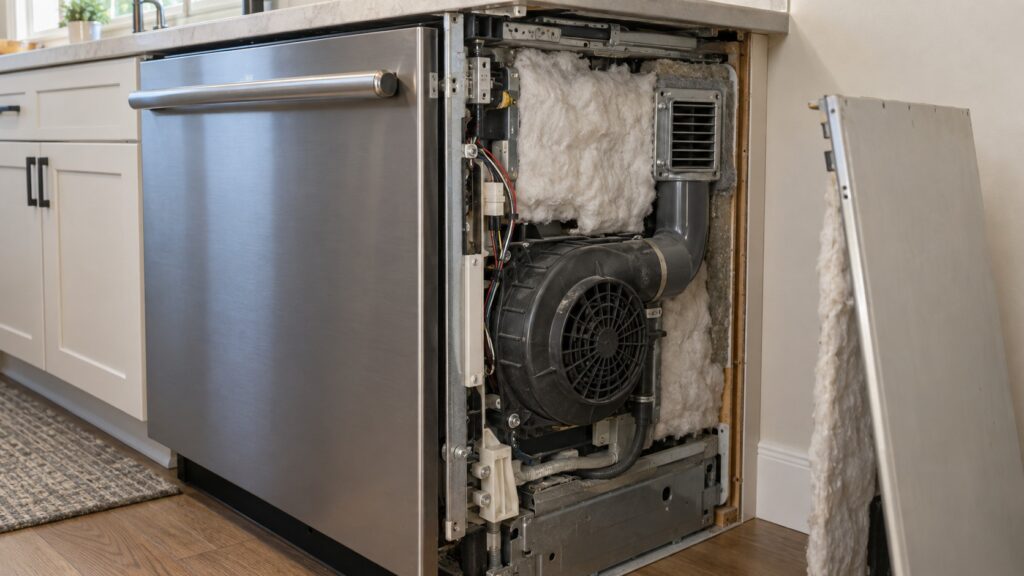
Ventilation. The fan moves the damp air out through the vent assembly so the moisture leaves instead of condensing back onto the load. This is the part F-5 is about.
Take the third away and the first two still work, which is why the symptom is “wetter than it used to be” rather than “wet.” An owner who has always run the machine overnight and emptied it in the morning may not notice for months.
Why do wet dishes not always mean F-5?
Because most wet-dish complaints never produce a code. Before blaming the fan, walk the ordinary list.
A useful test: run one load of nothing but ceramic plates and glasses on the longest program, with rinse aid full. If that load comes out dry, the machine is drying and the complaint was the load. If that load comes out wet and F-5 is showing, the fault is real.
Which faults look like this one but are not?
Heating and drying get confused constantly, because a cold final rinse produces wet dishes too. On this platform the heater has its own code, and a machine that never reaches temperature in wash or rinse is a different repair with a different part. If your complaint is that the water never gets hot, start with the heating diagnosis instead of this page.
Drainage is the other near neighbor. Water left in the sump at the end of a cycle wets everything in the lower basket and smells within a day, and it is a pump question, not a fan question. The full reading of the code, with its parts list, is on the page for Dacor Dishwasher F-5.
What can an owner check?
Keep to the door and the cabinet front. The drying fan and its harness sit inside the outer skin of the machine, and the dishwasher is plumbed and wired where you cannot see.
Check the vent opening on the door or the upper front for a physical blockage — a stray label, a wrapper, a piece of a broken container. Check that nothing tall in the upper basket leans across it. Fill the rinse aid reservoir and set the dosage a step higher if the water is hard. Run a hot cycle empty with the machine’s own cleaning routine, since a greasy vent path moves less air than a clean one; the schedule for that is in dishwasher maintenance.
Stop before the panels. Do not remove the outer door panel or the kick plate to reach the fan. There is line voltage behind both, a water inlet, and a door-lock assembly that is not designed to be reassembled by feel.
When is the fan motor a service call?
Call when F-5 stays after a power cycle, when it returns on every program, when the fan is audible but nothing moves at the vent, or when the vent area is warm and wet at the end of a cycle. A technician measures the fan circuit, checks the harness where it crosses the door hinge — a common wear point on any machine with wiring through a door — and inspects the vent assembly for grease before replacing a motor.
On a machine this old the repair-or-replace conversation is legitimate, and we would rather have it honestly than sell a part into a dishwasher with three other problems waiting.
We are an independent repair company and not a factory service arm. Pricing starts from a diagnostic visit and we confirm the estimate before any work begins. Dacor dishwasher repair covers fans, heaters, pumps, sensors and controls, and you can schedule a visit online.