
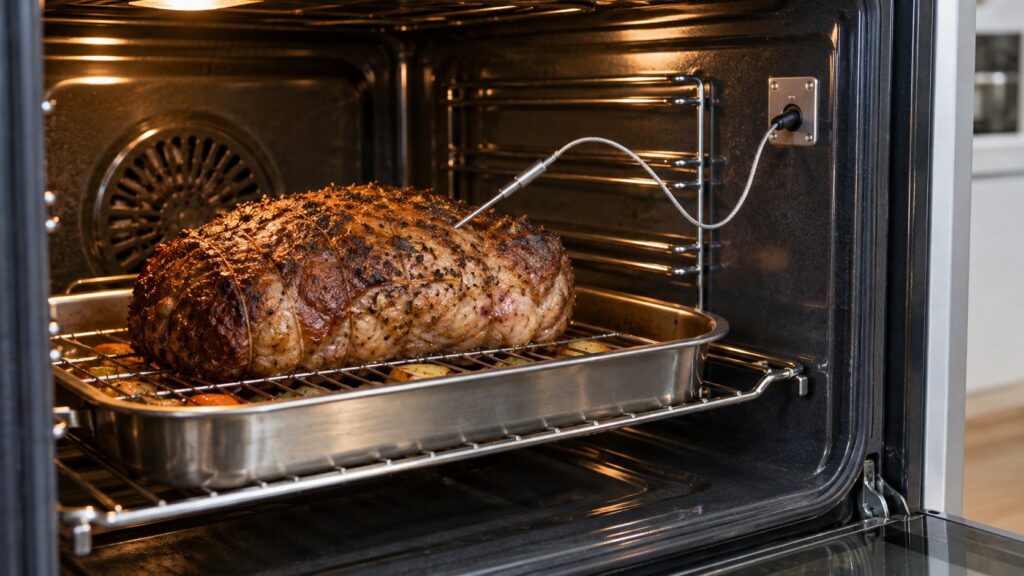
The Dacor meat probe is a temperature sensor on a cable that plugs into a jack inside the oven cavity, so the oven can follow the middle of a roast instead of the air around it. When that circuit stops making sense, the Samsung-era ovens and ranges answer with C-23: the temperature probe sensor has been read as shorted while the oven was operating. The parts behind the code are short — the probe itself, the jack it plugs into, and the main PBA that reads them.
What does the Dacor meat probe actually measure?
It measures one point: the tip. The oven holds a target for that point and manages the cavity to reach it, which is a different task from holding a set air temperature for a set time. That is why a probe cook can finish forty minutes earlier or later than a recipe says without anything being wrong — a rolled roast tied thick at one end and thin at the other genuinely does reach temperature at a time no timer could predict.
The consequence for diagnosis is that the probe is a second temperature circuit in the oven, entirely separate from the cavity sensor that governs preheat and bake. The two fail independently and produce different codes, and treating one as the other is the most common wrong turn here.
What does C-23 mean on a Dacor oven?
It means the control read the probe circuit as shorted while a cook was running. A short is a path for current where the design expects resistance that varies with temperature, so the board is being handed a reading it will not act on. Because it is raised during operation rather than at startup, the usual trigger is heat, movement or moisture rather than a part that was already dead when the door closed.
Three things produce it in practice. A probe cable crushed in the door seal, which is easy to do and leaves a visible flat spot. Moisture or fat in the jack, from a splattering roast or from a probe pushed into the jack with greasy fingers. And a probe that has been washed in a dishwasher or soaked in a sink, which is the fastest way to end the life of any sealed sensor on a cable. The parts list for the code is on the page for Dacor Oven C-23, and the same code on a range is covered at Dacor Range C-23.
Why does the jack fail more often than the probe?
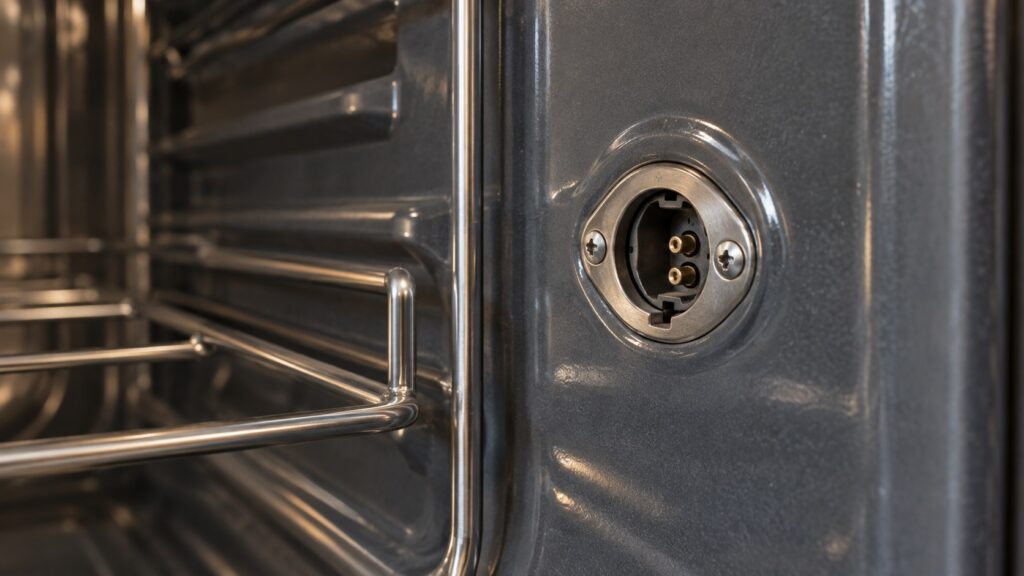
Because of where it lives. The jack is a small connector mounted in the wall of a cavity that runs to roasting temperature, gets splattered, and is wiped down by hand. Everything that lands on the cavity wall lands on it. Fat that carbonizes across two contacts behaves exactly like a short, and no amount of probe-swapping fixes it.
One more pattern belongs on that list. A probe that reads plausibly but finishes every roast twenty degrees early has not shorted and will not raise C-23 at all; it has drifted, and the only way to catch drift is to check the finished food with a separate instant-read thermometer. Drift is an argument for a new probe, not for a service visit.
That table is also the whole owner-side diagnostic. It costs nothing, needs no tools, and tells a technician more than a description of the symptom.
Is a cavity sensor code the same thing?
No, and the difference is worth holding on to. The cavity sensor is what stops the oven heating when it fails, and on the Legacy platform it is the F3 and F4 pair, compared in F3 versus F4. A probe fault leaves the oven perfectly able to bake — cancel the probe program, take the probe out, and the appliance works normally.
The lettering tells you which table you are reading from. C-numbers belong to the Samsung-era generation and F-numbers to the Legacy one, and the two lists are laid out side by side in oven F-codes versus C-codes. A code with a C and a hyphen is never a Legacy code, whatever a general search result suggests.
How should the probe be stored and cleaned?
Treat it as an instrument, not a utensil. Wipe the stem with a damp cloth while it is still warm, dry it, and never put it in the dishwasher or leave it soaking. Do not coil the cable tightly around the handle; the conductors break at the bend. Store it where it will not be buried under sheet pans, because a crushed cable is the failure mode that produces exactly this code.
Two habits during cooking matter as much. Route the cable so it leaves the cavity along the door seal rather than across the latch side, and never close the door on a probe cable that is stretched tight. Keeping the cavity clean helps the jack directly, and the routine is in wall oven maintenance.
When do you need a technician?
Call when C-23 appears with nothing plugged into the jack, when a second probe produces the same code, when the code returns at the same point in every cook, or when the jack looks damaged or scorched. Replacing a jack means reaching wiring inside the cavity wall, which is behind the liner on a built-in appliance, and that is not an owner-side job.
Before that, try the free test: unplug everything, run a short bake, and see whether the oven is happy. A quiet oven with no probe attached is a strong hint and a cheap one.
We are an independent repair company and not a factory service arm. Pricing starts from a diagnostic visit and we confirm the estimate before any work begins. Dacor oven repair covers probes, sensors, jacks and control boards, and you can schedule a visit online.