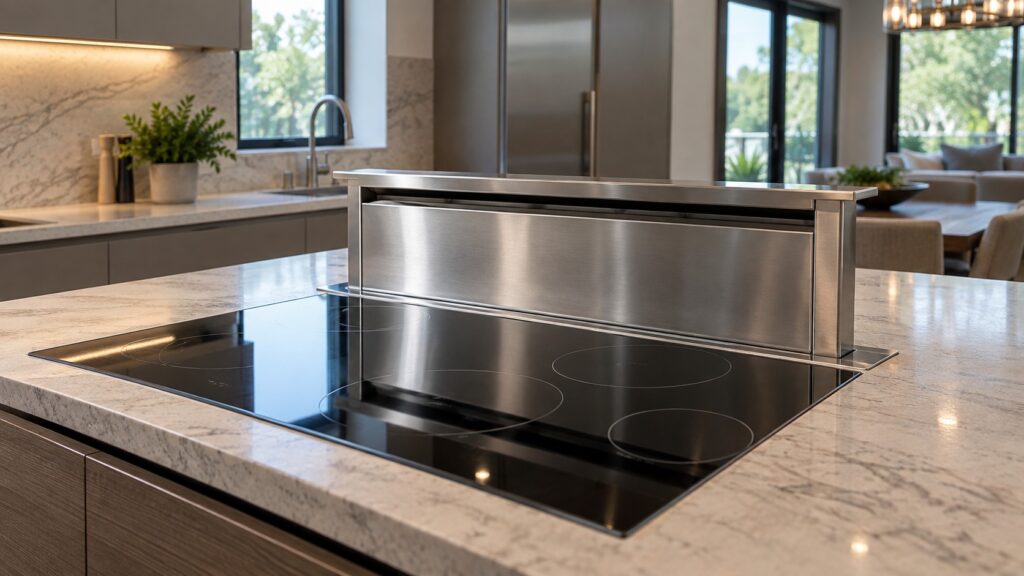
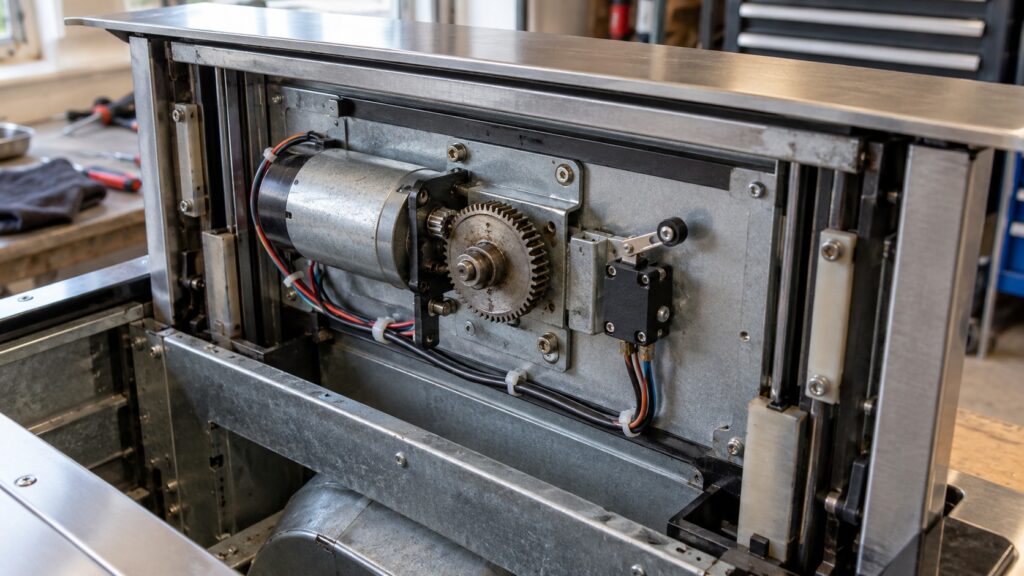
A Dacor downdraft vent that will not rise is a mechanical problem before it is anything else. The parts that move it are a lift motor, a drive gear, a limit switch and the harness feeding them, and the fault is almost always in that short list rather than in the blower that does the actual extraction. This is the part of the appliance owners most often misdiagnose, because a vent that stays down and a vent that rises but pulls no air feel like the same complaint from the kitchen side and are two completely different repairs.
What makes a Dacor downdraft vent stop rising?
Four things, and they sound different from each other. A motor that hums without moving is usually loaded — something is in the way, or the gear it drives has jammed. A motor that runs audibly while nothing happens is usually a stripped drive gear. Silence is either no power reaching the motor or a limit switch telling the control the vent is already where it should be. And a vent that starts up and then stops halfway has generally hit an obstruction, which is the one case an owner can often fix.
Obstruction is worth starting with because it is so ordinary. A downdraft rises through a slot immediately behind the cooking surface, and anything that lands in that slot rides up with it: a skewer, a chopstick, a spatula handle, the corner of a trivet pushed back too far. Grease that has dried in the guides does the same thing more slowly, stiffening the travel until the motor can no longer complete it.
Does a downdraft vent show an error code?
No. Ventilation on these kitchens is the one category with no fault-code table to read, which is set out plainly in why Dacor range hoods have no error codes. Nothing will appear on a display to tell you which of the four parts failed, and any code list you find online for a hood belongs to some other appliance.
What you get instead is behavior, and behavior is diagnostic if you listen to it properly. Our page for this exact symptom lists the parts involved: Dacor downdraft vent not raising. Describing the sound accurately when booking — hum, run, silence, or a stop halfway — is worth more than any code would be.
What can I check in five minutes?
Everything on this list happens with the cooktop and the vent switched off and cool.
Clear the slot. Look down the opening the vent rises through with a flashlight. Remove anything in it. Do not reach in with a metal tool.
Clean the visible travel path. With the vent in its lowest position, wipe the exposed edges and the frame with a degreasing cleaner and dry them. Sticky guides account for a real share of these calls.
Check the filters and the cassette. A grease filter or an inner cassette not seated correctly can foul the travel. Reseat it and try again.
Power cycle at the breaker. One minute off, then on. A control that lost track of the vent’s position sometimes finds it again on a fresh start.
Try one cycle and listen. Hum, run, silence, or a partial rise. Write down which one you heard.
Then stop. Do not pull the unit out of the counter and do not remove the housing. The lift assembly sits in a cabinet shared with a gas line or a cooktop supply on most installations, and the vent body is heavy enough to injure fingers when it releases unexpectedly.
Season matters more than people expect on a downdraft. The first cold week of the year brings a run of these calls, because a mechanism that has been stiffening quietly all summer meets a cooler, thicker film of grease and finally stalls. Nothing failed that night; the margin simply ran out.
How do I tell a lift fault from a blower fault?
The blower side is a different economic conversation as well as a different repair, and it is worked through in repair or replace the blower. Weak airflow that has crept up gradually is usually about ducting rather than the appliance, and the sizing rules are in duct sizing and makeup air.
Does cleaning actually prevent this?
For the lift mechanism, yes, more than for most appliances. Every cooking session sends grease past a moving assembly with guides and a gear, and grease that is wiped away weekly never becomes the varnish that stiffens travel. Filters washed on schedule also keep the load on the whole unit lower. The routine is in range hood maintenance.
One habit is worth adding on a downdraft specifically: lower the vent before wiping the countertop behind the cooktop, not after. Wiping around a raised vent pushes crumbs and liquid straight into the slot the vent has to travel through.
When should a technician open the cabinet?
Call when the vent will not move after the slot is clear and the unit has been power cycled, when the motor hums without movement, when the vent rises and drops back, or when travel has become slow and noisy. The repair means removing the unit from the counter and reaching the lift assembly, with the appliance supported so it cannot drop.
We are an independent repair company and not a factory service arm. Pricing starts from a diagnostic visit and we confirm the estimate before any work begins. Dacor range hood repair covers lift motors, gears, switches, blowers and controls, and you can schedule a visit online.