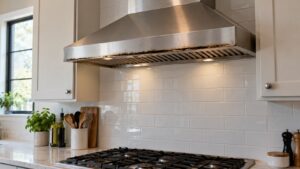
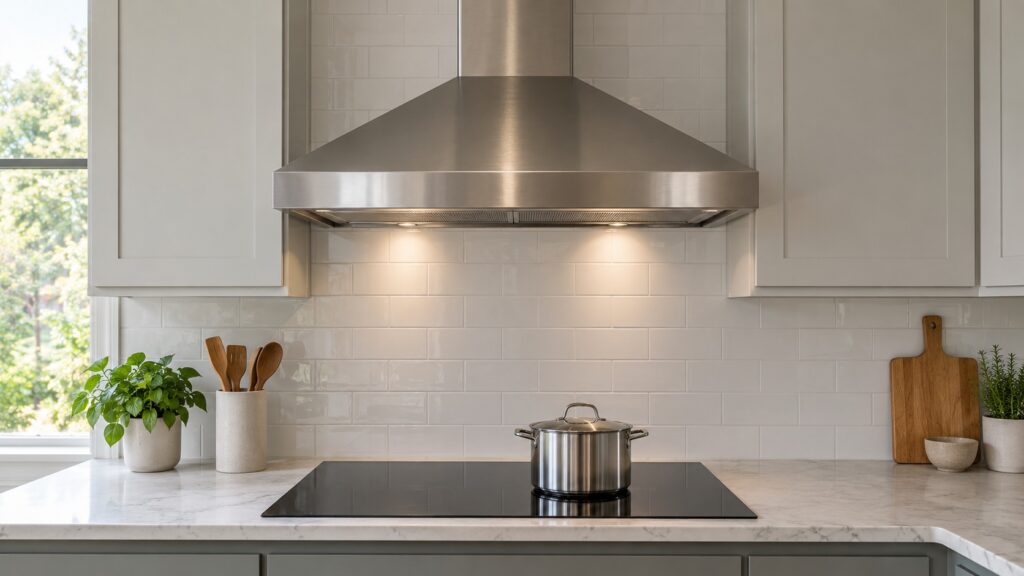
How Dacor range hood works is simple in principle: a blower pulls the smoke, steam and grease-laden air from above your cooking surface through a grease filter, then pushes it through a duct to the outside. CFM, short for cubic feet per minute, is the usual way to describe how much air a hood’s blower can move, and the rated figure for your hood is on its specification sheet, not on this page. What you actually get in the kitchen depends on three more things: a clean filter, a short and straight duct, and a fan speed that matches what you are cooking.
How does a Dacor range hood work?
The path of the air is the whole idea. Cooking releases smoke, steam and grease into a rising column of hot air. The hood sits above it, and the blower draws that air into the hood through the grease filter, then pushes it through the duct to an exterior outlet. A hood works best when it captures the plume before the plume spreads into the room, which is why mounting height above the cooking surface matters, and why our installation page says the right height is in your model’s installation instructions rather than a general rule.
Dacor’s current hoods come in three forms, per our range hood pages: Pro-Canopy wall hoods such as the DHD36U990CS and DHD48U990CS, a chimney wall hood, the DHD30U990WS, and liner inserts such as the DHD36U790LS that mount inside a custom cabinetry enclosure. All three share the same blower, control and lighting architecture underneath their finishes. The difference is in how they look and mount, not in the basic way air is moved. Our range hood buying guide compares them.
What is CFM and why does it matter?
CFM is a measure of volume of air per minute. A higher rating means the blower can move more air, in general. We give no CFM figure for any Dacor hood here, because our pages do not publish one, and the figure for your model belongs on its specification sheet. Two cautions apply whatever the number is. First, a rating is for the blower under test conditions; our installation guide says an undersized duct restricts airflow regardless of how powerful the blower motor is. Second, more is not automatically better, because a hood that exhausts a large volume of air can create negative pressure in a tightly sealed house, which is why our installation page suggests evaluating makeup air for larger installations with a ventilation contractor.
What does the blower do, and what can go wrong with it?
The blower is a motor driving a fan wheel inside a housing. It runs at several speeds, which you choose on the control. Our maintenance page says the parts that wear are the blower motor, the grease-filter indicator sensor and the lighting circuit, and that on most models those are independent of one another. A fan that will not turn on despite confirmed power points at the blower or the control, a rattle or buzz can come from grease and dust in the housing, and a fan that runs but moves little air is usually a filter or duct problem rather than a failed motor. Our guide on range hood repair or replace when the blower fails covers what a genuinely failed blower means.
Why do the grease filter and the duct decide how well the hood works?
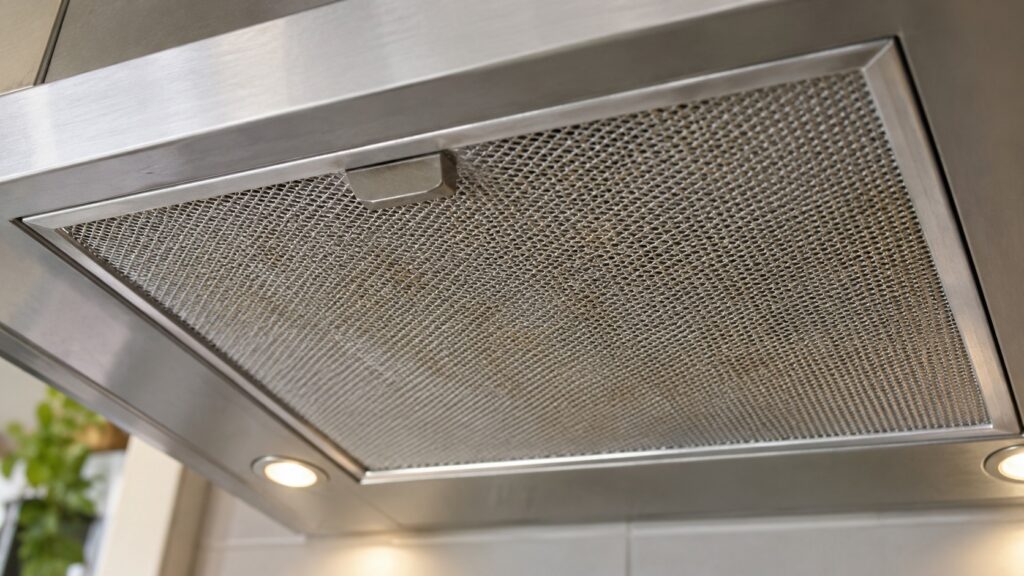
The filter is directly in the path of all the air the hood pulls in. A loaded filter restricts flow, and a clogged filter is one of the most common reasons for weak airflow when the fan still sounds normal. Our tips guide says that for typical cooking a metal mesh filter wants cleaning every two to four weeks, and sooner with frequent frying or high-heat searing. How to remove, wash and reseat the filter on your model is in the owner’s manual; a filter that is not fully seated can also stop the filter light from clearing.
The duct is the part you cannot see. Our installation guide says to route the shortest, straightest path to the exterior, because every additional bend reduces effective airflow, particularly on larger 48-inch hoods moving more air. Over months, grease can narrow a duct gradually, so a hood that slowly gets weaker usually reports a slow buildup. You can check the exterior vent cap for debris, snow or nesting material, and leave the rest of the duct to a professional.
Which fan speed should you use?
Match speed to what is on the cooktop. Our tips guide names low speed under high-heat cooking as the top cause of complaints that a hood is weak. Turn the hood on before you start cooking and leave it running a little after, as your manual advises. If your hood has an Auto-On feature, our range hood pages say it switches the fan on when it senses genuine heat below the hood and is a safety feature, not a malfunction, so a hood that starts by itself with a hot pan nearby is usually behaving as designed.
If grease on the cooktop ever catches fire, cover the pan with a lid and turn off the heat; do not turn the hood on and do not pour water. For the habits that keep airflow up, our range hood airflow and lighting tips and the maintenance guide go step by step.
When does a hood need a technician?
Book when the fan will not start, will not shut off, rattles after cleaning, or when airflow stays weak after you clean the filter and check the exterior cap. There is no code to read; our page on why Dacor range hoods have no error codes explains that the maker’s manual troubleshoots in plain English. Do not open the housing, the blower or the wiring yourself. If you see sparks or smell burning, switch off the hood’s breaker at the panel while standing on a dry floor. Our Dacor range hood repair page explains what a visit covers.