
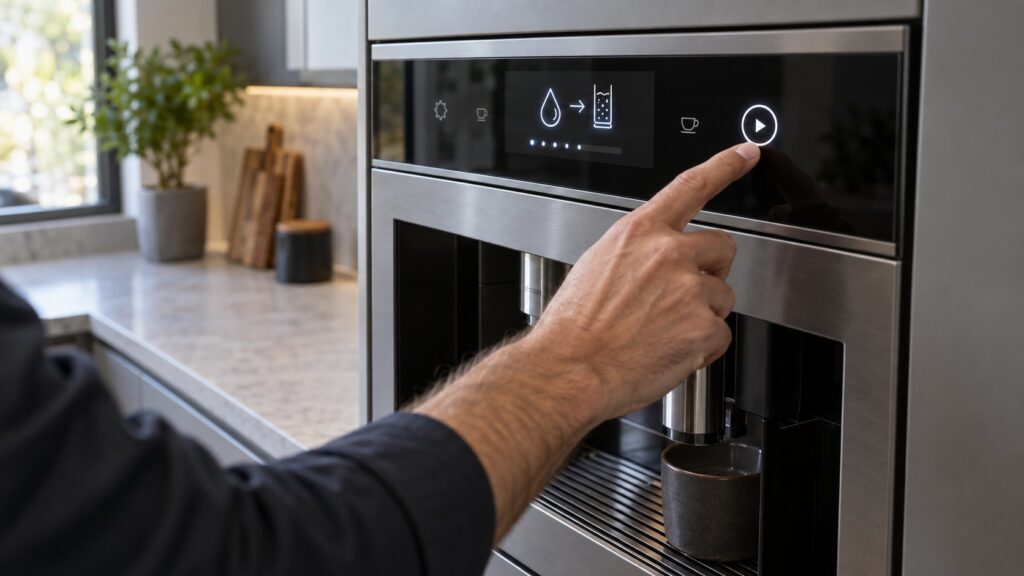
Dacor coffee machine descaling needs to happen on a schedule tied to water hardness and how often the machine runs, not on a fixed calendar date, because mineral scale builds up inside the boiler and internal lines in direct proportion to how much hard water has passed through them. Skip descaling long enough and the symptoms show up as a boiler that takes longer to heat, a descaling cycle that will not complete, or a temperature error that looks like a sensor fault but is really scale insulating the sensor from the water it is supposed to be reading. Getting ahead of scale buildup is one of the few maintenance jobs on this appliance an owner can do without opening the machine at all.
How often should a Dacor coffee machine actually be descaled?
The honest answer depends on the household’s water hardness more than on any fixed interval, which is why the machine’s own reminder — based on a water hardness setting entered during setup — is a better guide than a generic monthly rule. A household on genuinely soft water can often stretch descaling to every two to three months without trouble; a household on hard well water may need it monthly to keep the boiler and flow paths clear. If the water hardness setting was never configured correctly during setup, the reminder will be wrong in either direction, so it is worth confirming that setting rather than assuming the built-in prompt is already accurate for your supply.
What happens inside the machine if descaling is skipped?
Scale deposits build up first in the boiler, where the water sits and heats, and then along the narrower internal lines and valves where flow is already tightest. The boiler is the more forgiving of the two for a while — a scaled boiler just takes longer to reach temperature — but the narrow lines are not: a partially scaled flow path produces a weak, sputtering shot, a machine that reports a flow error even though water is technically getting through, or a descaling cycle itself that cannot complete because the solution cannot flow fast enough to satisfy the cycle’s own internal timer. Our Dacor coffee system temperature error guide covers how to tell a scaled sensor path apart from an actual sensor failure, since the two produce a similar-looking error.
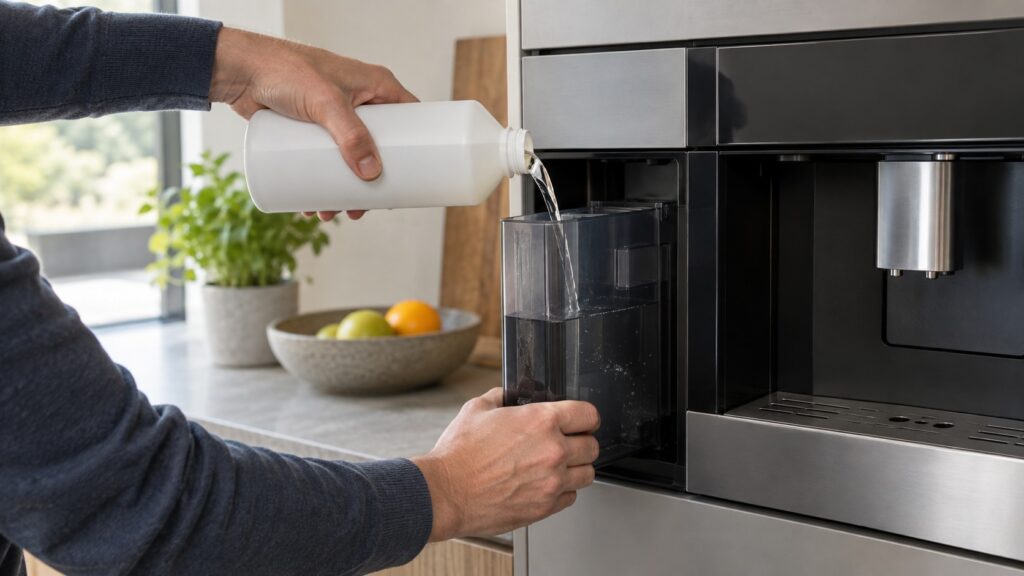
What solution should be used, and what should never be used?
Only a descaling solution made specifically for espresso and coffee machines belongs in this appliance. Vinegar is a common home remedy for other kitchen appliances, but its acidity and residual odor are not suited to the seals and internal materials in a built-in coffee system, and using it can leave a taste behind that is harder to clear than the scale it removed. General household descalers formulated for kettles or coffee makers of a different design can also behave differently in a machine built around a boiler and pressurized flow paths, so sticking to a solution rated for this category of appliance is the safer route, even though it costs more than a bottle of vinegar.
Why does a descaling cycle sometimes fail to complete?
A descaling cycle that stalls partway through is very often telling you that scale buildup has already progressed further than a single cycle can clear, particularly if descaling has been overdue for a while. Running the cycle a second time with fresh solution frequently resolves it, since the first pass clears enough of the buildup for the second to flow normally. If the cycle keeps failing after two attempts, that points toward scale that has hardened enough to need more than a solution can dissolve on its own, which is the point to book a service visit rather than repeating the cycle indefinitely and hoping it eventually clears.
Does descaling frequency change with how often the machine is used?
Yes — usage and water hardness both drive the same buildup, so a machine used several times a day accumulates scale faster than one used a few times a week, even on identical water. A household that uses its coffee system heavily on hard water sits at the worst end of both factors and should treat the machine’s descaling reminder as a minimum rather than a maximum. Conversely, a lightly used machine on soft water can sometimes go longer between descaling cycles than the reminder suggests, though letting the interval stretch indefinitely on the assumption that light use means no scale is building is not a safe habit — scale still forms, just more slowly.
Does the water hardness setting need to be re-checked over time?
A household’s water supply is not always as constant as the initial setup assumes — a municipal supply can change source or treatment over time, and a well supply can vary seasonally, so a hardness setting entered once during installation is not guaranteed to stay accurate for the life of the machine. If descaling reminders start feeling clearly too frequent or too infrequent compared to what the machine actually needs, re-testing the water hardness and re-entering the setting is worth doing before assuming the reminder logic itself has gone wrong.
What other maintenance goes alongside descaling?
Descaling addresses mineral buildup, but it is not the only upkeep a built-in coffee system needs. The brew group and any milk path on models with a frother need their own periodic cleaning cycles, separate from descaling, and skipping those leads to a different set of symptoms — weak or watery coffee, a jammed brew group, or a frother producing no foam — that a descaling cycle will not fix on its own. See our Dacor coffee system repair tips for the fuller upkeep routine beyond descaling alone.
If your Dacor coffee machine is showing a boiler, flow, or temperature symptom even after a proper descaling routine, our technicians can confirm whether scale is still the cause or whether a component has actually failed, before any part is ordered. We are an independent repair company, not a factory service arm, and pricing starts from a diagnostic visit with the estimate confirmed before any work begins. Schedule Dacor coffee machine repair or book a visit directly.