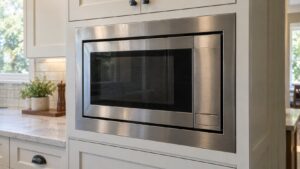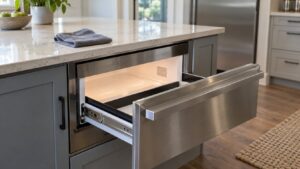
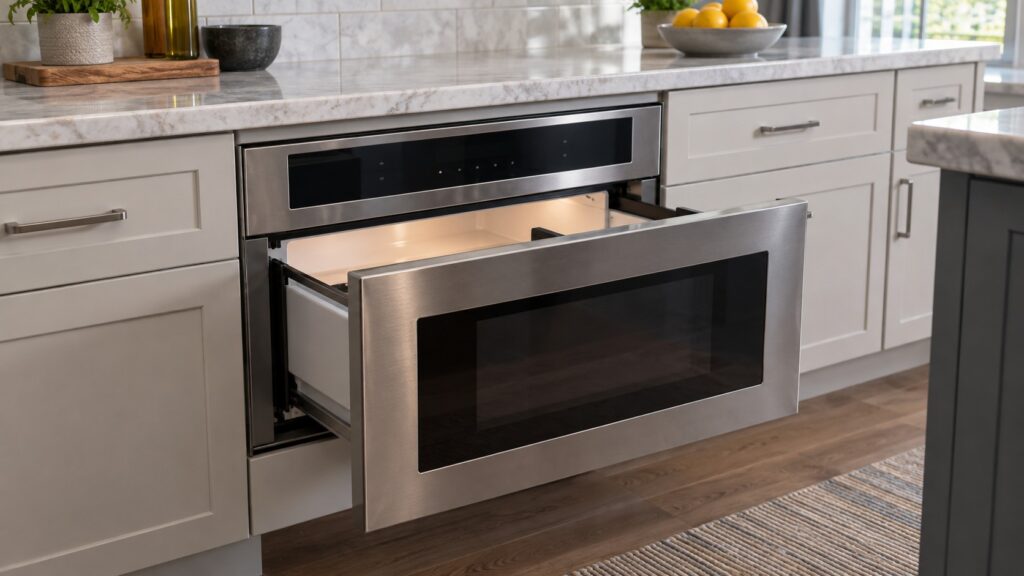
A Dacor drawer microwave won’t open for one of a small set of mechanical reasons, and the DMW2420B stalling on its slide is a textbook case — the mechanism at fault is nothing like a standard microwave door. A drawer microwave opens and closes on a motorized slide mechanism rather than a hinged door, which means the failure points are completely different from a standard microwave whose door will not latch. When a drawer microwave will not open, will not close, or stalls partway through its travel, the cause is almost always mechanical — the drive motor, the slide rails, or the sensor that tells the control board the drawer has reached its end position — rather than an electronic fault with the cooking circuit itself.
How is a drawer microwave’s opening mechanism different from a door?
A standard microwave door hinges open and is held shut by a latch assembly and a set of door switches the control board reads to confirm it is safely closed before allowing the magnetron to run. A drawer microwave has none of that — instead, a motor drives the drawer along a set of slide rails, and a position sensor confirms when the drawer has reached fully open or fully closed. That means the two units fail in different ways for what sounds like a similar complaint: a standard microwave’s door usually fails at the latch or the door switches, while a drawer microwave’s open-close problem usually traces to the motor, the rails, or the position sensor instead.
What should you check first if the drawer won’t open?
Confirm the control panel is responding at all — if pressing the open button produces no sound, no light change, and no response anywhere on the panel, the fault may be in the control board or power supply rather than the drawer mechanism itself, and that is worth ruling out before assuming a motor problem. If the panel responds normally but the drawer itself does not move, listen for the motor: a motor that hums or clicks without the drawer moving points at a stripped drive gear or a jammed mechanism, while complete silence from the motor points more toward a blown motor fuse or a wiring connection that has failed.
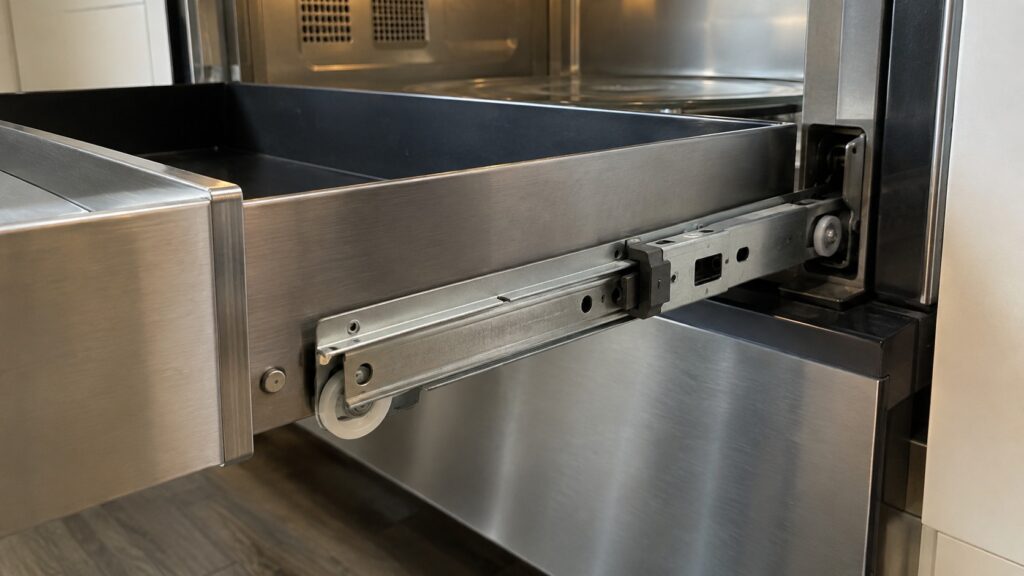
What causes a drawer that won’t close all the way?
An obstruction on the slide rails is the first thing to rule out, and it is also the easiest to fix — grease buildup, a dropped utensil, or debris that has worked its way onto the rail track can stop the drawer just short of fully seated. If the rails are clear and the drawer still will not confirm closed, the position sensor that tells the control board the drawer has reached its closed position may be misaligned or failing, which produces a symptom that looks identical to a mechanical jam but has nothing to do with the rails at all. A drawer that looks closed but that the control panel refuses to start cooking from is a strong sign the sensor, not the mechanism, is the actual fault.
Why does the drawer stop partway through its travel?
A drawer that starts moving and then stalls before reaching either end is usually a mechanical binding problem — rails that have accumulated enough grease or debris to add resistance the motor cannot overcome, or a drive gear that has worn enough to lose grip partway through the stroke rather than failing outright. This is a different symptom from a drawer that never moves at all, and it is worth describing precisely which one is happening when booking a repair, since it points a technician toward a different part of the mechanism from the start.
Is a drawer microwave’s motor fuse different from a household fuse?
Yes — the fuse protecting the drawer’s drive motor is an internal component sized specifically for that motor circuit, not something interchangeable with a household fuse or breaker, and it is not something to attempt to bypass or replace with a higher-rated part. A blown motor fuse is a symptom of something else drawing more current than it should, most often a motor that is binding against a mechanical obstruction, so replacing the fuse alone without checking why it blew tends to produce the same failure again shortly after.
What else on the microwave might actually be at fault?
If the open-close mechanism is working normally but the unit reports an error, will not heat, or otherwise misbehaves once the drawer is closed, that points away from the mechanism entirely and toward the microwave’s other systems. Our Dacor microwave only says error guide covers what to do when the display gives no specific information beyond a generic fault, and our Dacor microwave tips cover the sensor-cooking and turntable side of the appliance separate from the drawer mechanism.
Is a stuck drawer safe to force open?
No — forcing a drawer that will not move under motor power risks damaging the slide rails or the drive gear further, turning what might have been a motor or sensor repair into a full mechanism replacement. If the drawer is stuck with food or cookware inside and needs to be opened before service can be scheduled, that is a question worth asking a technician by phone rather than working at the mechanism with tools, since a drawer microwave’s internal layout is not designed for a forced manual release the way some appliance doors are.
If your Dacor drawer microwave will not open, will not close, or stops partway through its travel, our technicians can identify whether it is the motor, the rails, or the position sensor before any part is ordered. We are an independent repair company, not a factory service arm, and pricing starts from a diagnostic visit with the estimate confirmed before any work begins. Schedule Dacor microwave repair or book a visit directly.