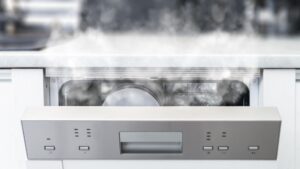
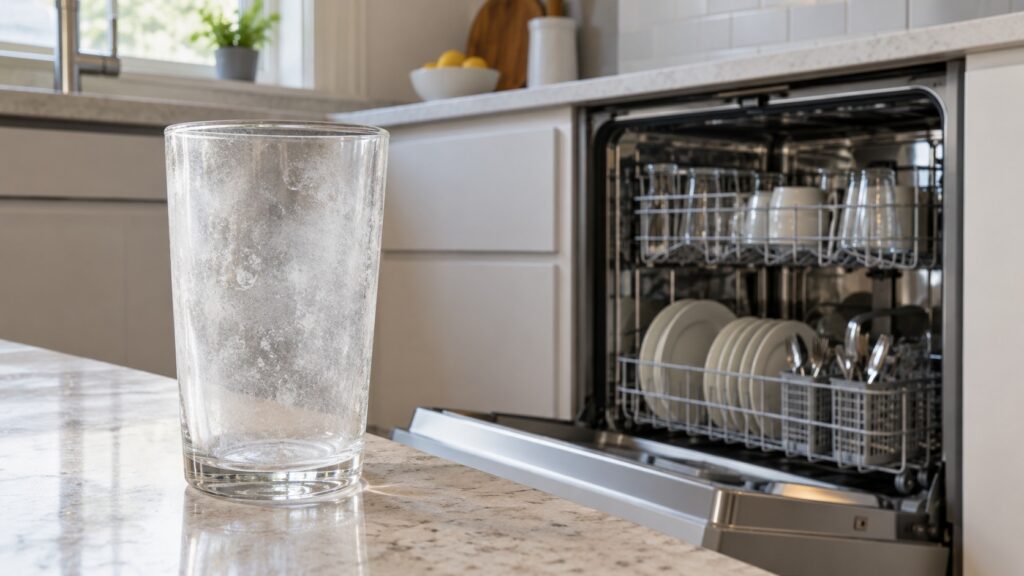
Dacor dishwasher cloudy glasses and a white film are almost always a water-treatment problem, not a wash-pressure problem. Our pages say film on glass comes down to three things: the built-in softener needs salt and needs the local water hardness set correctly, rinse aid decides whether water sheets off or dries in place, and detergent dosing and age matter as well. Before you suspect the pump or the arms, check those, and wipe a glass to learn whether you have a removable film or permanent etching.
Why do glasses come out of a Dacor dishwasher cloudy?
Hard water leaves minerals behind. When the water dries on a glass, it leaves a film, and the film looks cloudy or white. Our pages say a Dacor dishwasher such as the DDW24G9000AP is documented with a built-in water softener, and our feature glossary explains why: an ion exchange unit inside the machine, with its own salt reservoir, exists so hard water does not leave film on glass or scale on the heater. For it to do its job it needs salt and it needs the local hardness set correctly. Our StormWash poor cleaning results page puts it plainly: film on glass is water treatment, not wash pressure, so spinning arms and clearing jets will not fix it.
Where the salt goes, how to set hardness and how the machine signals low salt is different on each model, so use your manual for those steps. We cannot give you a setting number, because it depends on your own water.
Is it a film or is the glass etched?
Tell them apart before you change anything. Wet one cloudy glass and rub it with a cloth. If the cloudiness lifts or changes, it is a film of deposits and the cure is water treatment. If it stays and looks like a permanent frosting that follows the glass’s surface, that is etching, which is damage to the glass and not something the machine can reverse. Etching is a reason to check that you are not using too much detergent and that the water is not being over-softened, per the dosing guidance in your manual. Glass already etched has to be replaced; adjusting the machine only protects the next load.
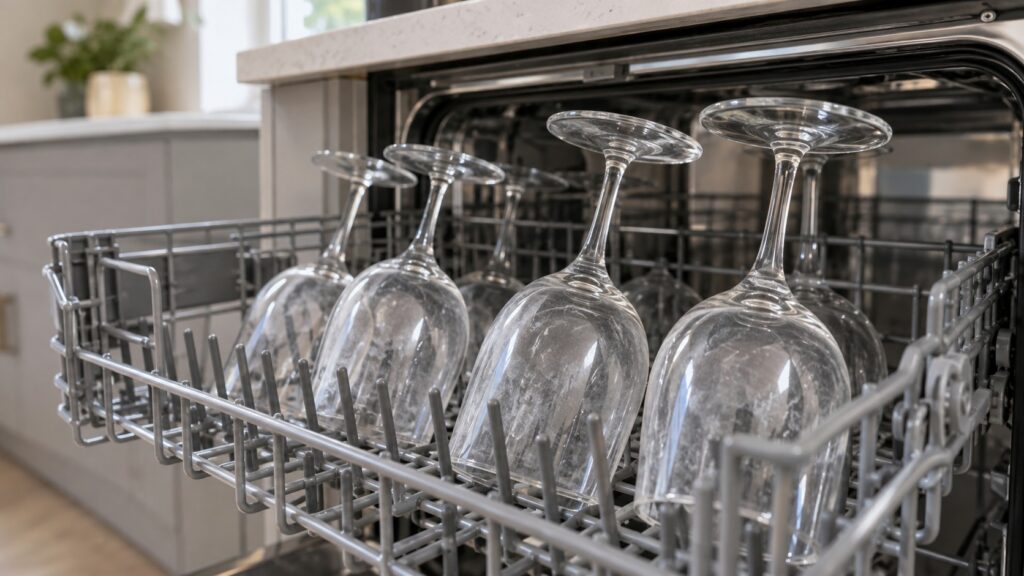
What should you check first for white film?
Go in this order. First, the salt: check the softener’s salt reservoir and refill it if it is low. Second, the hardness setting: our pages say it must match your local water, and a wrong or never-set value makes the softener work badly in either direction. Third, the rinse aid: our dishwasher tips and the leaving-dishes-wet page both say rinse aid changes how water sheets off the dishes, and an empty reservoir is one of the most common reasons for spots, film and wet dishes on any dishwasher. Fourth, the detergent: our pages say all-in-one tablets do not replace the softener, and in genuinely hard water a machine run on tablets alone scales up and gradually washes worse. Old tablets also lose strength, and detergent stored in a damp cupboard clumps.
Make one change at a time and run a couple of cycles before you judge, so you know which change worked. Our Dacor dishwasher repair tips cover the settings further.
Could loading or the filter play a part?
Yes, though less often than water. Our StormWash page notes that scraping rather than rinsing is the right pre-treatment, because modern detergents need something to work on, and a load rinsed clean under the tap can come out worse with a fine film left behind. A blocked detergent dispenser path also changes things: a tall pot handle can block the flap so the cycle runs with plain water. If the dispenser is the suspect, our dishwasher detergent not dissolving page lists the checks. Clean the filter and sump on the schedule in your manual, since a loaded filter recirculates debris and leaves dishes gritty rather than cloudy.
What should you not try?
Do not pour household chemicals into the machine, mix cleaners or run bleach alongside other products, and do not add anything not named in your manual to the salt reservoir or rinse-aid compartment. Do not open the machine, remove the lower access panel or pull it out of the cabinet to reach the softener or the plumbing. Water and electricity share that space. If water is reaching the floor or an outlet, switch off the breaker at the panel while standing on a dry floor, and never pull a plug from a wet outlet.
When should you call a technician?
Book when salt, hardness, rinse aid and detergent have all been corrected and the film keeps returning, when the machine’s cycle has become shorter or the dishes come out wet as well, or when you suspect the softener is not regenerating. The softener, the heater and the circulation system are measured rather than guessed at. Our page on a Dacor dishwasher that won’t heat water covers one related issue, and our dishwasher maintenance schedule keeps the routine. The Dacor dishwasher repair page explains what a visit includes.