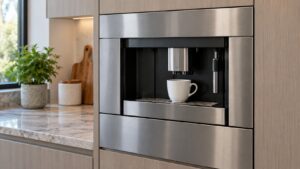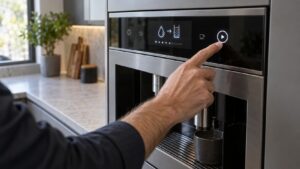
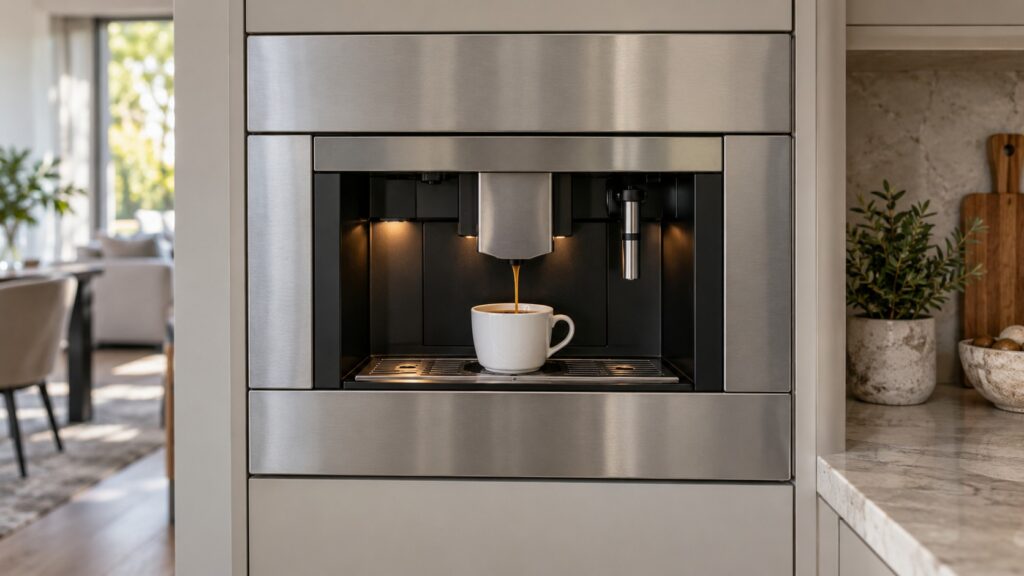
How Dacor built-in coffee machine works can be followed from the cup backward: water comes from a plumbed line or a refillable tank, a boiler heats it, a built-in grinder grinds the beans, a brew group handles the grounds while hot water passes through, and the used grounds drop into a bin you empty. Milk and steam run through their own path. The machine on our pages is the CM24P (plumbed) or CM24T (tank-fed) Automatic Coffee System, a discontinued platform. What each button does and how the routines run on your unit is in the Use and Care manual for your model.
How does a Dacor built-in coffee machine make a cup?
An automatic built-in coffee machine does in order what you would do by hand. It grinds fresh beans, wets the grounds with hot water, pushes the brewed coffee out through the spout and discards the spent grounds. Our pages describe the parts that carry out those steps on this machine: a built-in grinder, an internal boiler, a brew group and a used-grounds bin. The two configurations share all of them. As our page on the CM24P and CM24T differences says, they are the same platform with a single different water-delivery method.
The mechanical detail of how the brew group presses and moves, how much coffee goes in and at what temperature the water runs is model detail we do not have on our pages, so we will not state it. It is in the manual.
Where does the water come from, and why does it matter?
The CM24P-1 connects to a dedicated plumbed water line, which removes the need to refill a tank. The CM24T-1 draws from a refillable internal tank, which makes installation simpler where there is no water line but puts the job of keeping the tank filled and correctly seated on the owner. This matters when something goes wrong, because the same message has different causes. Our pages say “Flow Meter Error” on the tank-fed CM24T-1 means no water in the tank, while on the plumbed CM24P-1 a water-supply message points to the household plumbing connection, the shutoff valve or an inlet filter. Our plumbed and reservoir installation guide covers the two setups.
What does the boiler do?
The boiler is the internal vessel where water is held and heated. The machine has to fill it before it can brew, and our pages show that it watches how that goes. The message “Timeout Filling Up Broiler”, which our page on the boiler timeout explains, means the machine could not fill its internal boiler within the expected time, and it disables the buttons. Temperature has its own messages, “Error – Coffee Temperature” and “Error – Steam Temperature”, and our temperature error page covers them. Scale is the common slow-moving enemy: our descaling guide says it builds up in the boiler and then in the narrower lines and valves, so a boiler that takes longer to reach temperature is often the first sign.

What do the grinder and the brew group do?
The grinder reduces whole beans to grounds on demand, and the brew group is the mechanism that holds those grounds while the hot water passes through them. After the cup, the used grounds go into the bin, which is why the display tells you when it is not seated: our repair tips page says “Machine Ready – Drawer Out” means the used-grounds bin is not seated correctly. A message naming the group, “Xxxxxx Group Error”, and the routine prompt “Clean Group”, which appears every fifty cycles, refer to the brew group. Our page on a brew group jammed says a stuck group is the mechanical condition most often behind that group-error message. Do not try to free or remove the group yourself; it is a precision part inside the machine.
How do the milk and steam path fit in?
On models with a milk-dispensing button, milk takes its own route through the machine, and that route has to be cleaned. Our pages say “Please Milk Clean” appears automatically two hours after the milk button was last used and is a routine cleaning prompt, not a fault. A frother that produces no foam and a steam wand that is blocked each have their own pages on this site. Run the milk cleaning routine as your manual describes, because milk residue is what blocks the path.
Why does this machine show sentences instead of codes?
It is a design choice of the platform. Our pages say every problem indicator on the CM24P and CM24T is a full sentence in the Use and Care manual, so there is no code to look up, and “Machine Ready – Drawer Out”, “System Off – Front Panel Open” and “Flow Meter Error” are different situations. Write down the exact wording. Our page on why Dacor no longer makes a coffee machine adds that there is no current-generation replacement, so servicing the unit you have matters.
When does a coffee machine need a technician?
Book when a temperature or boiler message persists, when the flow meter message stays after you check the tank or the water supply, or when the group keeps jamming. Do not open the machine, remove panels or touch the boiler or wiring; it contains hot water and mains power. If water pools or reaches an outlet, switch off the breaker at the panel while standing on a dry floor. Our Dacor coffee machine repair page explains what a visit covers.