
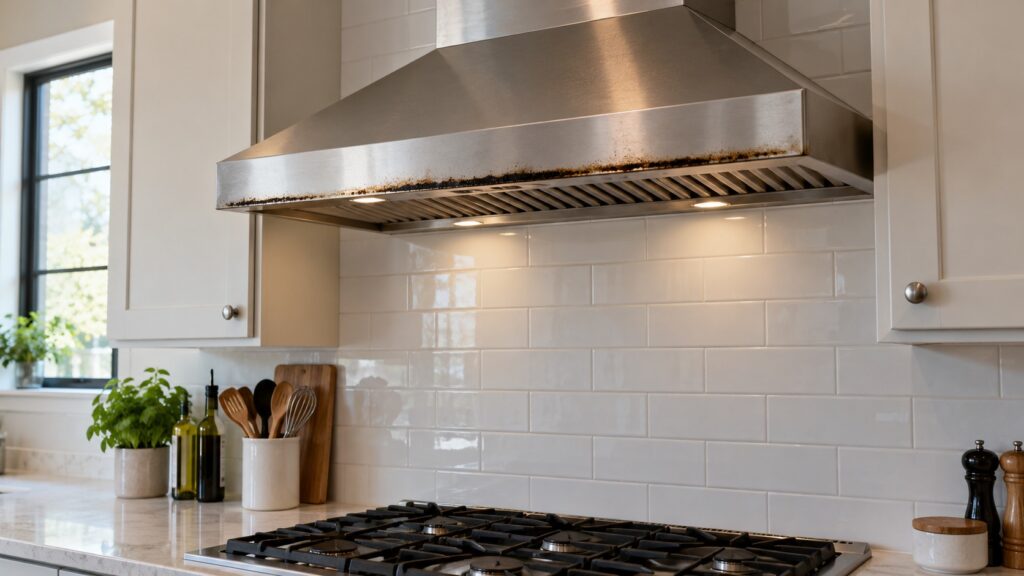
A Dacor range hood dripping grease is nearly always a sign that grease has built up faster than it has been cleaned away: the filters are saturated, grease has collected in the underside or the area around the fan inlet, or the hood has been working hard with a restricted duct. Dripping is not a code and not an electrical fault; our range hood pages say Dacor publishes no error code for any hood and that the maker’s manual troubleshoots in plain English. The owner’s job is to clean what can be reached safely, and to leave the blower housing and the duct to a technician.
Why is my Dacor range hood dripping grease?
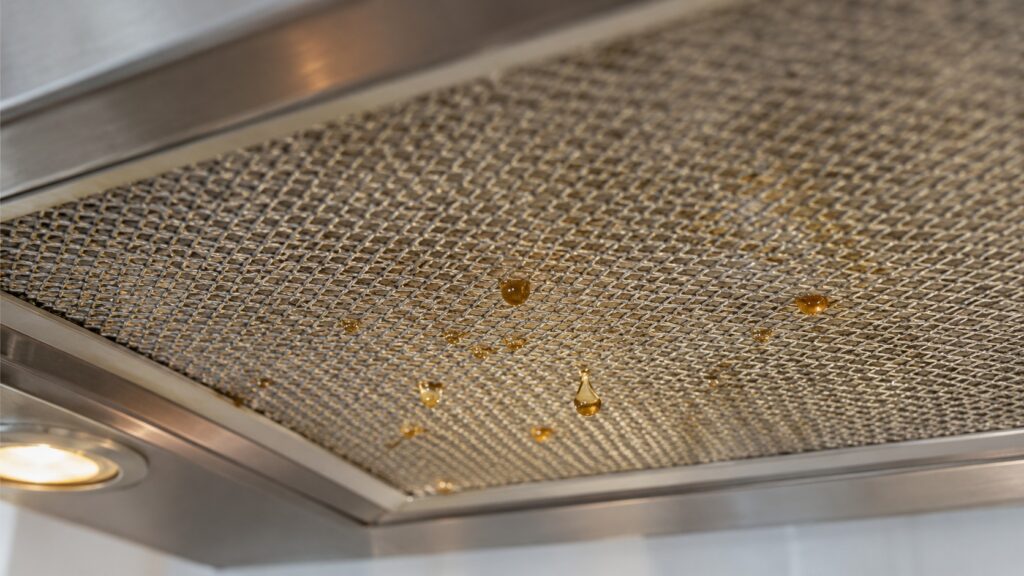
A hood’s job is to catch grease. Cooking sends grease into the air, the filters catch most of it, and what gets past settles on the surfaces around them. When the filters are full, they stop catching and grease runs down the nearest surface and drips. Our tips guide says airflow loss almost always starts at the grease filter, since it sits in the path of all the smoke and steam the hood pulls in, and that a filter that has gone visibly gray or sticky has already gone past the point where it should have been cleaned. A hood that drips is telling you the same thing in a more obvious way.
Look at where the grease appears. A drip from the lower edge of the hood or the filter frame points to the filters and the surfaces next to them. Grease that seems to come from inside the hood, or from the fan area, points deeper, and our maintenance page says grease and dust accumulation inside the blower housing, beyond the removable filter, is a deeper clean that is best done on a longer interval or by a technician.
What should you do first?
Switch the hood and the cooktop off and let everything cool completely. Then clean the grease filters. Our maintenance page says metal mesh filters typically wash in warm soapy water or a dishwasher on a routine schedule, and our tips guide says that for typical daily cooking, every two to four weeks keeps a metal mesh filter from building up enough grease to matter, and weekly for a household that fries often or sears at high heat. How to release and refit the filters on your model is in the owner’s manual. Make sure each filter is dry and fully seated when it goes back, since a filter that is not seated can also stop the filter indicator light from clearing.
Then wipe the reachable surfaces under and around the hood, the filter frames and the area around the fan inlet with a degreasing cleaner on a cloth, never sprayed into the hood. Our tips guide recommends wiping the exterior and the area around the fan inlet as a visual check for early signs of a filter or duct problem. Keep the cleaner off the touch controls and the lighting.
Could the duct or the blower be involved?
Sometimes. Our tips guide says the duct run can accumulate grease residue over months of use, especially on a longer run with more turns, narrowing it gradually. A restricted duct makes the hood work harder and can push more grease toward the hood than the filters can handle. Weak airflow, smoke that lingers over the cooktop and a hood that is dirtier than it used to be, together, suggest the duct. Our page on range hood weak airflow lists the common causes: grease-clogged filters first, then a blocked or crushed duct, a stuck damper and a duct that is too long or has too many bends. You can check the exterior vent cap or damper for debris and see that it opens freely; the rest of the duct is not an owner job.
What should you not do?
Do not remove the hood’s housing, the blower or any panel to reach grease inside. Do not spray liquid into the fan inlet or the controls. Do not run the hood while it is wet. If grease or water reaches the electrical parts, or you smell burning or see sparks, switch off the hood’s breaker at the panel while standing on a dry floor, and never pull a plug from a wet outlet. If grease on the cooktop ever catches fire, cover the pan with a lid and turn off the heat; do not turn the hood on and do not pour water on it. Heavy grease on filters and surfaces is also a fire hazard, which is a good reason to keep to the cleaning schedule.
How do you stop it coming back?
Keep to a filter routine matched to how you cook, and use a fan speed that matches what is on the cooktop; our tips guide names low speed under high-heat cooking as a top cause of complaints that a hood is weak. Wipe the hood’s exterior and the fan inlet area regularly so grease does not build where it is easy to ignore. Check that the filter is the right type and is seated. Our range hood maintenance guide and airflow and lighting tips go through the habits step by step.
When should you call a technician?
Book when grease keeps appearing after you have cleaned the filters and the reachable surfaces, when grease seems to come from inside the hood or around the fan, when airflow stays weak on the highest speed with clean filters, or when the hood rattles or buzzes. Our guide to the hood’s rattling or buzzing blower explains one related sign. A technician can clean the blower housing and check the duct, and our guide to range hood repair or replace explains what a failed blower means. The Dacor range hood repair page covers what a visit includes.