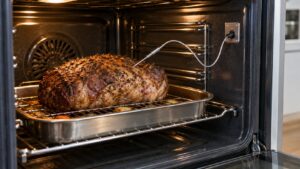
What F2 means on your Dacor oven (dacor oven f2)
Dacor oven f2 is Legacy Dacor’s (pre-2016) “Heating Mode High Temperature” problem: the ERC board has read cavity temperature climbing above what a normal bake or broil cycle should ever reach, and shuts the elements off as a safety response. This is one of the more serious codes on the Classic ERC table because the underlying condition is a runaway heat event rather than a comfort issue, and Dacor documents it that way. The most common physical cause is a relay that has welded closed and can no longer switch the element off on command, with the temperature sensor circuit as the second most likely path.

Symptoms
Before assuming F2 is the problem, check the behavior of your Dacor oven against the symptoms below, because several unrelated oven problems overlap here.
- F2 appears and the oven immediately stops heating, sometimes with a loud click from behind the control panel.
- The oven cavity feels noticeably hotter than the set temperature just before or when F2 appears.
- A burning or hot-metal smell may accompany the problem, especially the first time it trips.
- The oven may have been running unattended for an extended cook when the problem triggered.
- Subsequent bake attempts trip F2 again quickly, sometimes within minutes of starting.
Common causes
The list below covers what actually causes F2 on an oven, in the order a technician would eliminate them on a Dacor oven.
- Welded relay contact — the bake or broil relay on the relay board has fused closed and cannot de-energize the element.
- Failed or drifting temperature sensor — the RTD probe is reporting a temperature well below the cavity’s real temperature, so the ERC keeps heating.
- Sensor wiring failure — a loose or corroded connection between the sensor and the ERC produces a falsely low reading.
- ERC control failure — the board itself is not responding to the sensor input and is not cutting power to the element.
- Door seal or gasket issue — very rarely, extreme ambient heat buildup around a failing seal can influence the reading, though the relay and sensor are the primary suspects.
Troubleshooting steps you can try
These checks cost you nothing on an oven and often end the problem there; anything harder on a Dacor oven needs a technician.
- Turn off the oven and shut off power at the breaker immediately — do not leave a unit that has thrown F2 running or plugged in unattended.
- Let the oven cool fully before opening the door, and avoid touching the back panel or any internal wiring.
- Do not attempt to restart a bake cycle to “see if it happens again” — a welded relay will not clear itself.
- Note the oven temperature you had set and roughly how far into the cycle the problem occurred, for the technician.
- Keep the oven unplugged or the breaker off until a technician has confirmed the relay and sensor are safe.
Parts a technician may replace
A technician will work through the oven temperature sensor (rtd probe), bake and broil relay contacts, and electronic range control board on your oven. Genuine OEM or trusted-supplier parts are matched to the oven by model and serial number rather than fitted to an oven on spec.
When to call a technician
F2 is a runaway-heat safety code and should be treated as urgent: book a technician before using the oven again, since a welded relay can reheat the cavity with no way for the control to stop it. A High-severity problem on an oven is not one to work around: shut the oven down and book a technician. Your oven is repaired by an independent third party, not by the manufacturer, with 30 days of cover on our labor.
Related help and Dacor resources
A persistent the F2 condition on an oven is worth booking rather than repeating — arrange oven repair, or start with our guides. www.dacor.com has the manufacturer detail for the oven.