Buying a used Dacor appliance is a sound idea only if you check three things before you pay: which generation it is, whether it is complete and working, and how its parts will be sourced later. Dacor has built appliances under two different control systems, Legacy models made before Samsung closed its acquisition in September 2016 and Samsung-era models made since, and the generation decides which manual, which fault codes and which parts apply. The model number is the reliable signal, so photograph the rating plate before anything else.
How do you find out which generation a used Dacor is?
By the model number. Our page on which generation of Dacor you have says a wall oven or range with a model number beginning DOB, DOP, DOC, DTI or DTG is a Samsung-era Modernist unit, a range numbered ER30D, ER36D or ER48D or a dishwasher numbered EDW or IDW is Legacy, and a dishwasher numbered DDW is Samsung-era. It warns that a collection name will not tell you, because some collection names were sold on both sides of the 2016 acquisition. Copy the model number exactly as it appears on the rating plate. Our guide to how to read a Dacor model number explains what decodes reliably, such as the nominal size in inches after the prefix, and what does not.
Finding the plate takes a moment of thought. Our wall oven installation guide notes that on the DOP48M96DL the rating plate sits on the inner side of the door trim, but we do not know where it is on every model, so check the manual or ask the seller to send a photo.
Why does the generation matter for a used purchase?
Because it changes what happens when something fails. Our cost comparison says the labor for a repair is often similar across generations, but the parts for Legacy platforms have had far longer to thin out, so sourcing time is where Legacy appliances tend to cost more. A Legacy appliance is not automatically beyond repair, and our framework for deciding says era and component matter more than age. Read why Legacy Dacor repairs can cost more than Samsung-era repairs before you decide how much risk you are willing to take, and ask a technician about parts for your specific model before you buy if you can.
What should you inspect on a used Dacor?
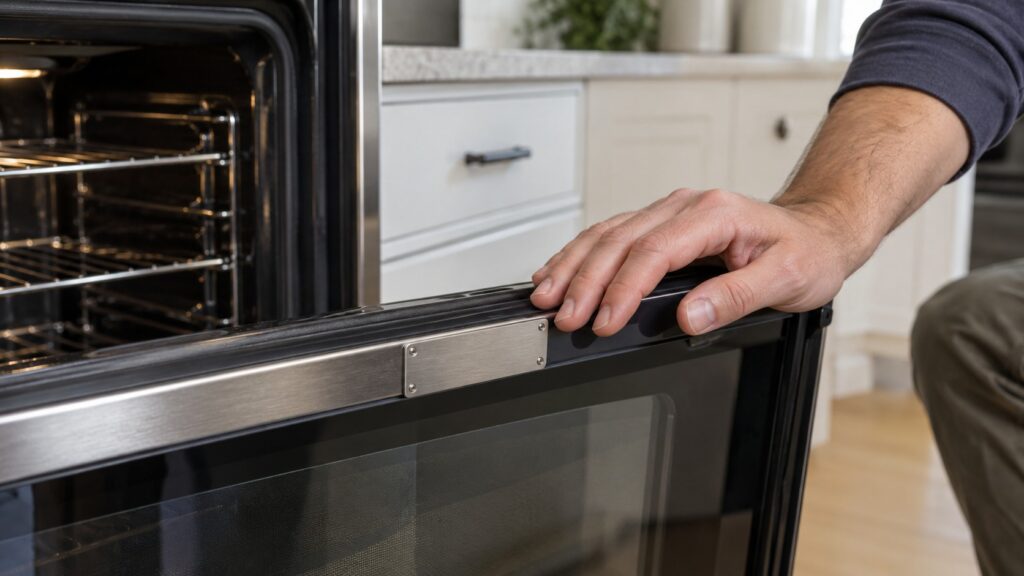
Look at the appliance as it would be installed. Ask for the manual, or confirm one can be found for the model number. Check that it is complete: racks, grates, knobs, drawers, shelves, filters and trim are all present, because missing pieces are a hidden cost. Run it if the seller can power it: does the display light, do the controls respond, does the fan run, does the oven heat, do the burners light, does a refrigerator or wine column cool. Look for cracked glass on a cooktop, a door that does not close squarely on an oven, a gasket that is torn or hardened, rust or water marks inside, and signs of a leak under a dishwasher or a refrigerator. Ask why it is being sold, and whether any codes or alarms have appeared.
What are the safety checks for a used range, rangetop or oven?
Gas and electrical connections are for licensed professionals. Never connect or disconnect a gas appliance yourself, and make sure a used gas range or cooktop is installed with its anti-tip arrangement as the instructions require; our range installation guide covers it. If you ever smell gas, do not switch anything on or off, leave the house and call your gas utility or 911 from outside. Do not buy an appliance whose seller reports a gas smell or sparks. Check that the unit has not been the subject of a safety recall by looking up its model on cpsc.gov yourself; we do not list recalls here.
Also think about the fit. Our wall oven guide notes that a single and a double oven of the same nominal width occupy different cabinet heights, so confirm single or double and the cutout against the installation sheet, not just the width.
Is a used panel-ready or built-in Dacor harder to buy?
Often, yes, because the appliance and its cabinetry are fitted together. Our pages say a panel-ready or built-in installation adds real cost and complexity to replacement, matching finish, hinge side and the cabinet opening precisely. A used column refrigerator with a left hinge will not suit a layout that needs a right hinge, and panel-ready units need a front panel that matches. Confirm the hinge side, the finish, the size and whether a front panel or finish kit comes with it. Our guide to a Dacor warranty that has expired explains what to expect on cover, because a used appliance almost certainly has none.
How do you decide whether the price is fair?
Compare the used price with a new model’s price on the maker’s specification sheet, then subtract for risk: unknown history, possible parts delays on a Legacy unit, the cost of a professional installation and any trim or kit you will need. We do not quote prices here. A used appliance in good order and of the Samsung-era generation is a lower-risk purchase than an old Legacy unit with a failed control, but the right answer depends on the unit in front of you. Our repair or replace framework for any Dacor appliance helps you think about the repair side of a purchase.