
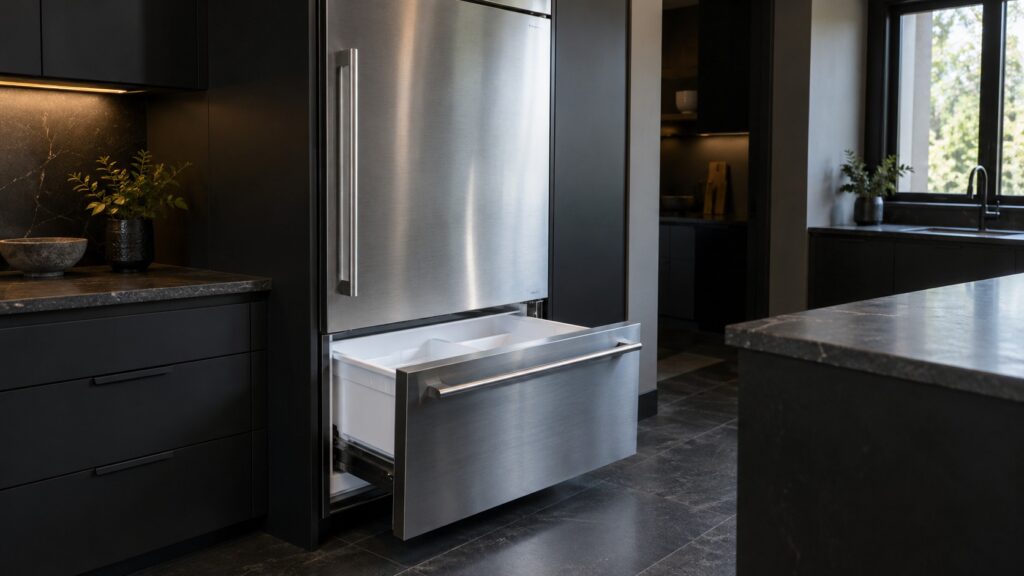
Dacor FreshZone explained in one line: it is the name for a separately controlled drawer inside a Dacor column refrigerator, meant to hold items at a temperature different from the main cavity. It has its own sensor and its own damper, which is a small flap that meters cold air into the drawer, so it can run warm or frosty while the rest of the column holds its set point. What the drawer does on your exact model, and how its setting is changed, is in the owner’s manual.
What does FreshZone mean on a Dacor refrigerator?
FreshZone is a brand term, not an industry standard, and it names one piece of hardware you can point at in the kitchen: a drawer within a column refrigerator that is controlled on its own. The main cavity is held to a set point, and the drawer is allowed a share of that cold. Dacor’s list of feature names, which we explain in our glossary of Dacor feature names, describes it as a drawer for items that want a different temperature from the main cavity. That is all the name promises. It does not describe a particular temperature, and it does not say which models carry the drawer, so check your model’s manual before assuming yours has one.
Knowing the name matters in a repair conversation. Saying “the FreshZone drawer is warm but the shelves are cold” describes one compartment and points straight at a sensor, a damper or airflow. Saying “the refrigerator is warm” describes an outcome with many possible causes.
How does a FreshZone drawer work?
In general terms, this is how a drawer with its own temperature control is built. Cold air in the column is metered rather than poured. The cabinet holds the main cavity at its set point, and the drawer takes a share of the cold air through a damper. The damper opens and closes according to the drawer’s own sensor. Set the drawer colder and the damper spends more time open; set it closer to the cavity and it spends less time open.
That arrangement explains behavior that owners often read as a failure. A drawer packed to the roof blocks the damper outlet, so the air that should reach the back of the drawer never arrives. A drawer that will not close fully leaks cavity air past the gasket continuously. Neither is broken hardware. What the damper and the sensor do on your exact model, and how fast the drawer responds, is in the owner’s manual.

Is FreshZone the same thing as PreciseCooling?
No, and the two names are easy to mix up. PreciseCooling is the dedicated compressor and evaporator arrangement on column refrigeration, so a column holds its own temperature independently of its neighbor. FreshZone is the drawer inside one column. The column’s cooling and the drawer’s share of it are two different systems stacked on each other. Our guide to how Dacor PreciseCooling works covers the first; this page covers the second.
The practical consequence is simple. If the whole cabinet drifts warm, the shelves show it as well as the drawer, and the question is about the column. If only the drawer is wrong, it is a question about one compartment.
Does FreshZone show an error code?
Not in the way people expect. Dacor refrigeration does not carry a printed fault-code table like the cooking appliances do, and codes circulating online for this equipment are usually borrowed from other brands. What the appliance does produce are alarms through the app and the panel: a door left open, an abnormally high temperature reading, a filter reminder and a self-check result. An alarm tells you the cabinet noticed something; it does not tell you which compartment caused it. Our page on why Dacor refrigerator error codes are not real explains the difference.
What can an owner safely check on a FreshZone drawer?
Four things, none of which needs a tool. First, unpack the drawer and leave the back of it clear so air can enter and circulate. Second, push the drawer fully home, because a package caught behind it holds it open without being obvious. Third, confirm the drawer’s own setting, which is separate from the main cavity and can be changed by accident; how to read it is in the manual. Fourth, check that the cabinet door is sealing, since a column that leaks cold air starves the drawer first.
To tell the drawer from the column, put a glass of water with a thermometer on a middle shelf overnight and another in the drawer. Both warm means the column; drawer only means the drawer. Give any change a night before judging it, because a column full of food carries a great deal of thermal mass and a short wait tells you nothing.
Do not push a tool through the damper outlet to free a stiff flap, and do not remove the drawer housing or any interior panel. The housing is trimmed to fit an integrated cabinet, a bent flap turns a setting problem into a parts order, and opening the cabinet is a technician’s job.
When does a FreshZone problem need a technician?
Book when the drawer stays wrong after a second overnight check with the load reduced and the setting confirmed, when the drawer frosts while the shelves are correct, when you can hear the damper cycling constantly, or when an abnormally high temperature alarm repeats. A technician checks the drawer’s sensor against a real temperature, then the damper for movement, then airflow. Take your two overnight readings with you; they shorten the visit more than any description of the symptom.
If the drawer is warm and food is at risk, move perishables to a cooler first. Our full diagnosis page, Dacor FreshZone drawer running warm or frosting, goes through the checks in order, and the column refrigeration repair page explains what a visit covers.