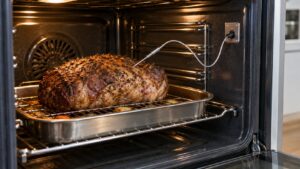
What C-d1 means on your Dacor oven (dacor oven c-d1)
Dacor oven c-d1 is the Modernist wall oven’s door-lock mispositioning code: the main PBA has commanded the door lock to a specific state — locked or unlocked — and the lock’s own position feedback is not confirming it arrived there. Samsung-era Dacor double wall ovens use an electronically driven lock for self-clean cycles, and c-d1 is the board’s way of flagging that the lock and its sensor disagree about where the mechanism actually is. Unlike c-d0, this is a mechanical safety problem rather than a touch-panel nuisance code, and Dacor rates it Medium severity accordingly.
Symptoms
The signs below separate this condition on your Dacor oven from other problems that present almost identically on an oven.
- C-d1 appears on the display, most often when starting or ending a self-clean cycle.
- The oven door may feel like it is not fully latched even though it looks closed.
- A clicking or grinding sound can come from the lock area as the motor tries to reach position.
- Self-clean may refuse to start, or may abort partway through, when c-d1 triggers.
- Normal baking and broiling may be unaffected if the problem appears only during a lock/unlock attempt.
Common causes
More than one thing can produce C-d1 on an oven, so the causes below are ordered by how often they turn out to be responsible on a Dacor oven.
- Door lock motor not reaching its commanded position — binding or partial mechanical failure stops the motor short.
- Lock position sensor failure — the sensor reports the wrong state even though the lock has physically moved correctly.
- Door alignment issue — a door slightly out of alignment with the frame can prevent the latch from seating fully.
- Wiring failure to the lock assembly — a loose connector interrupts the feedback signal to the main PBA.
- Debris in the latch mechanism — buildup from spills or self-clean residue can physically obstruct the lock.
Troubleshooting steps you can try
Before booking a visit for C-d1, work through these on your oven — a good share of these oven calls resolve right here.
- Check that the oven door closes flush and latches with a firm, even push before trying self-clean again.
- Power-cycle the oven at the breaker and retry the function that triggered c-d1.
- Do not force the door open if it appears locked — wait for the lock cycle to time out on its own.
- Wipe visible debris from the door latch area if it is safely accessible with the oven off and cool.
- Avoid repeated self-clean attempts while c-d1 is recurring, since it stresses the same lock mechanism each time.
Parts a technician may replace
On an oven in this condition the likely candidates are the door lock switch and motor assembly, door latch, and main pba. Each is tested on the oven before it is replaced, and the part is matched to your oven from its model and serial number.
When to call a technician
Because c-d1 is a door-lock safety problem rather than a cosmetic one, a technician should confirm the lock motor and sensor are working correctly before the oven is used for self-clean again. At Medium severity the oven is not in danger, though a C-d1 that keeps coming back on an oven is telling you something. Nobody here works for Dacor; we are an independent service, and the work we do on your oven is warranted for 30 days.
Related help and Dacor resources
When the C-d1 condition survives everything above, the oven needs a technician: book oven repair, or browse our repair guides first. The original oven specification lives at www.dacor.com.