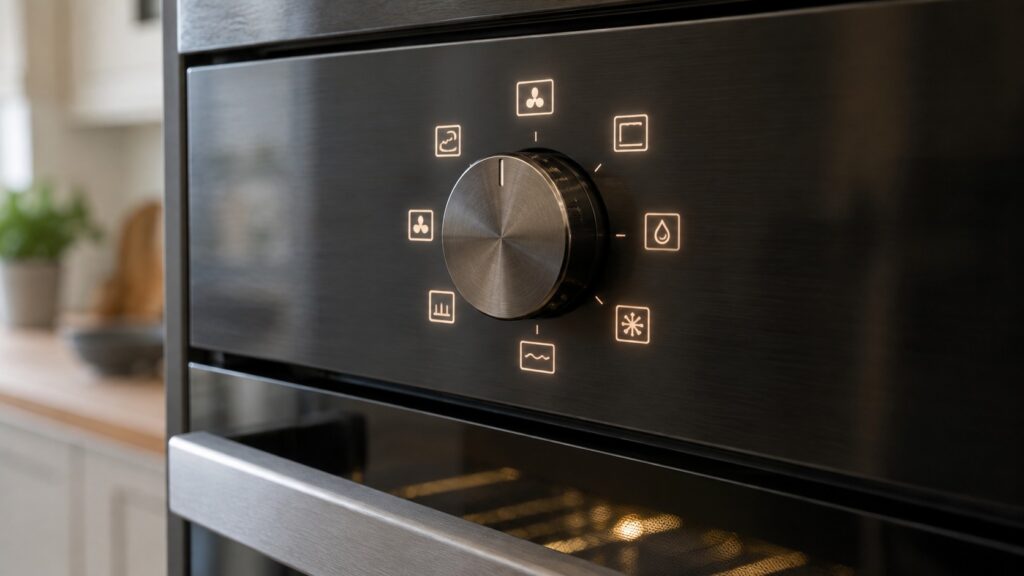
Dacor oven modes are the settings that decide which elements and fans run. Bake heats from below and above, convection adds a fan, Pure Convection spreads the work across several elements and fans, roast and broil lean on the top, steam adds moisture, proof holds a gentle warmth and self-clean locks the door and runs very hot. Exact names vary by model, so match them against your own manual.
Open the mode menu on a Dacor oven and you will find a list of names that are easy to mix up. Knowing what each one actually does helps you cook better, and it also helps you describe a fault: “the oven bakes unevenly in convection but not in plain bake” tells a technician far more than “the oven is off.” This glossary explains the common Dacor oven modes in plain language, what runs in each, when to choose it and which symptom page on this site to read if a mode misbehaves. Your model may use slightly different words, so treat the list as a guide to the idea behind each mode and read the manual for its exact labels.
What do the main Dacor oven modes mean?
Most modes are a different mix of three things: heating elements, a fan and, on some models, steam. Plain bake uses the bottom element and the top element, with no fan, and gives gentle, even heat for cakes and casseroles. Convection modes add a fan so that hot air moves across the food. Broil uses the top element at full power for browning and finishing. Special modes such as proof, steam, meat probe and self-clean build on that base.
What is convection, and what makes Pure Convection different?
Convection means moving air. A fan at the back of the oven pushes hot air around the food, which strips away the cool layer that surrounds it and browns the surface faster. That is why convection recipes use a lower temperature or a shorter time, often about 25 degrees Fahrenheit lower than the same recipe in plain bake. The result is crisp skin on roasts and even color on a full tray of cookies.
Pure Convection is the name used for a more elaborate version, with several elements and fans that work together rather than a single fan. Because more than one part is involved, a fault can affect only one region of the cavity, which shows up as food that browns on one side. Our glossary of Dacor feature names places Pure Convection alongside the brand’s other named features. If your oven bakes unevenly, the oven baking unevenly page and the convection fan not running page list what to check.
How are roast and broil different from bake?
Roast is meant for larger cuts and vegetables: it browns the outside while the inside cooks through, and on many ovens it uses convection to do so. Broil is the opposite extreme, intense radiant heat from the top for a few minutes, so food needs watching. A broil element that does not glow is a recognizable fault, and the broil element not glowing page covers it. Never leave the oven unattended while broiling, keep pans clear of the element and use the rack position the manual recommends.
What are steam, proof and meat probe modes?
Steam mode adds moisture to the cavity from a water reservoir or supply, so bread rises with a crisp crust and leftovers reheat without drying. A steam oven has real plumbing, scale builds in hard water and the system needs descaling, which our RealSteam oven buying guide explains. Proof mode is a gentle low heat that gives yeast dough a warm place to rise. It is not a cooking mode, and it should never be used to hold hot food for hours.
Meat probe mode uses a temperature sensor you insert into the food. The oven cooks until the inside reaches the target and then holds or stops, which takes the guesswork out of roasts. If the probe is not recognized or the oven shows a probe message, the guide on the Dacor meat probe explains what the oven is telling you.
What does self-clean do, and why does the door lock?
Self-clean heats the oven far beyond normal cooking temperatures so that food soil turns to ash, which you wipe away afterward. For safety the door locks during the cycle and stays locked until the cavity has cooled. A lock message is not a fault, and the Dacor oven door lock codes compared guide helps you tell a normal lock from a problem. Remove racks if the manual says to, wipe up large spills first and ventilate the kitchen, because the cycle can smoke. If the cycle will not start, read the self-clean won’t start page.
How do I use mode names when I describe a problem?
Say which mode you were in, what you set, what you expected and what happened. “Preheat takes twice as long in bake” points at an element or sensor, which is a different search from “the fan is silent in convection.” The guide to a Dacor oven that won’t reach temperature shows how that detail narrows the cause. If the display shows a letter code, the Dacor oven F-codes versus C-codes guide explains the families. For any fault you cannot fix yourself, see Dacor oven repair or schedule a visit.