Dacor oven life expectancy has no single figure that we can honestly give you, because our pages do not publish one and a number from memory would be a guess. What we can say is what decides how long a Dacor oven stays worth keeping: which generation it is, which part has failed and how the oven sits in your kitchen. Our own framework puts those ahead of age, because a well-built older oven with one serviceable fault can be a perfectly sensible repair, while a newer oven with a major failure can be a closer call. This guide shows how to judge your oven on those terms.
How long does a Dacor oven last?
There is no honest single answer. The maker’s documentation for your model and your own experience are the best guides, and we have found no figure on our pages that we can stand behind. Lifespan depends on how the oven is used, how it is cleaned, how its door seal and racks are treated, and what fails over time. A better question is whether your oven is worth keeping today. Our guide to repair or replace a Dacor appliance puts three questions ahead of age: which era is it, which component failed, and how complex is the installation. Age comes fourth, because on this platform it is the least reliable signal.
Is your oven Legacy or Samsung-era?
Start with the model number. Our page on which generation of Dacor you have explains that everything built before the Samsung acquisition closed in September 2016 is Legacy, with Dacor’s own boards, and everything since is Samsung-era Modernist, and that a wall oven or range with a model number beginning DOB, DOP or DOC is Samsung-era. The era decides the parts conversation. Our cost comparison says the labor for a repair is often similar between the two, but Legacy parts have had far longer to thin out, so sourcing time is where Legacy ovens cost more. A Legacy oven is not automatically beyond repair, and nothing on our pages says an oven of a given age should be replaced.
Which oven failures are worth repairing?
Most of them. Our oven repair-or-replace page says most problems on either generation are worth fixing outright. A sensor, a door seal, a fan, an igniter or element, a lock or a keypad membrane are serviceable on nearly every Dacor oven regardless of era, and our general framework says the same. Where the question gets real is a failed control board on an old Legacy oven: our page says the codes F5 (failed self-diagnostic) and F6 (EEPROM checksum error) both call for full ERC board replacement, the most expensive single repair on the Classic ERC oven platform. See when a Legacy ERC board is not worth fixing for how that decision usually goes.
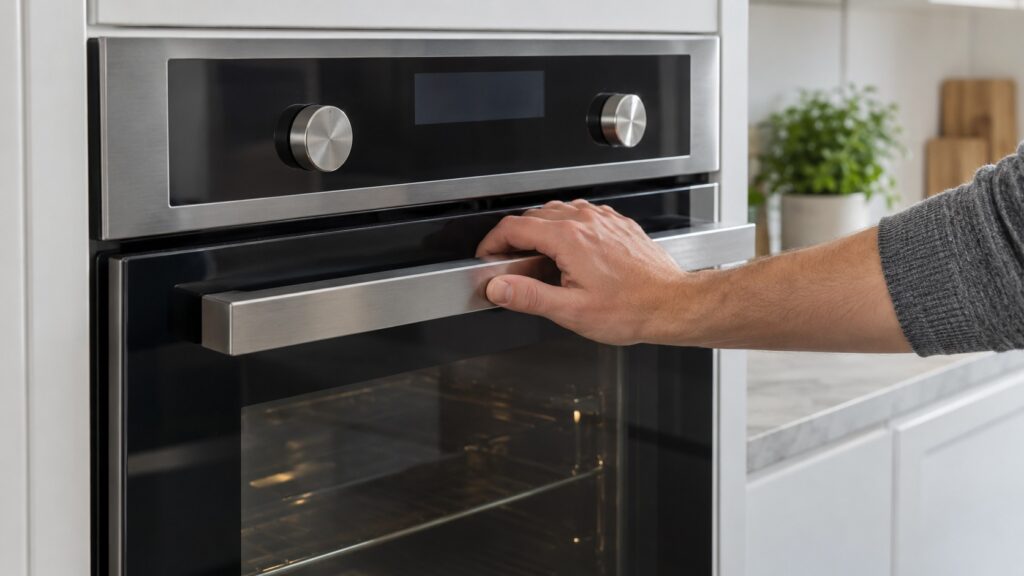
What signs suggest the oven is nearing the end?
Do not rely on one symptom. Look for a pattern: repeated unrelated repairs, a door seal that no longer seals and a cavity that has rusted or been damaged, a control board failure on an oven whose parts are hard to find, or an oven that no longer fits how you cook. A single failed part on an otherwise sound oven is not a sign of the end. Our uneven-baking and oven-does-not-reach-temperature pages list the common causes, a worn gasket, a sensor, a fan, and most are repairable; see oven won’t reach temperature. Keeping the oven in good order helps too, and our wall oven maintenance guide explains what prevents many F-codes.
How do you weigh repair against replacement?
Ask a technician to identify the failed part and confirm whether a genuine part is available for your model. Then compare: the repair against a new oven plus its installation, any cabinet or cutout changes and a dedicated 240-volt circuit if one is not already in place. A part swap is usually far cheaper than a new unit when the oven is otherwise sound. A built-in wall oven also sits inside custom cabinetry, so replacing it with a different size can mean cabinet work, as our wall oven installation guide notes. If your plans already include a kitchen remodel, that changes the balance. We do not quote prices here.
What should an owner never do on an aging oven?
Do not remove panels, test wiring or work on the control board. If you smell burning or see sparks, switch off the breaker at the panel while standing on a dry floor; never pull a plug from a wet outlet. If the oven is part of a gas range and you smell gas, do not switch anything on or off, leave the house and call your gas utility or 911 from outside. Do not keep resetting a breaker that trips repeatedly. Our Dacor oven repair page explains what a diagnostic visit covers.