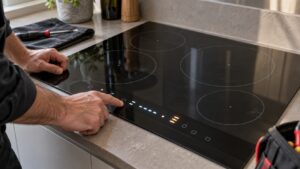
What Pan Not Detected means on your Dacor cooktop (dacor cooktop pan not detected)
What follows is a cooktop symptom, documented by Dacor in words rather than as a numbered error code. — induction cooking works by magnetically coupling with the base of the cookware, and if the pan does not have enough magnetic material, the zone will simply stay inactive with no code at all rather than report a problem. This is normal induction behavior, not a malfunction, and it is one of the most common calls an induction cooktop owner makes before realizing the issue is the cookware rather than the appliance. Aluminum, copper, and some stainless steel pans without a magnetic layer built into the base will not activate any induction zone regardless of how the cooktop is set.
Symptoms
Check the cooktop against each of these before concluding anything: Pan Not Detected on a Dacor cooktop looks a lot like several cheaper problems.
- A zone shows no response at all when a specific pan is placed on it, with no error indicator.
- The same pan fails to heat on every zone of the cooktop, not just one.
- A different pan on the same zone heats normally, isolating the issue to the cookware.
- The pan may feel notably lighter than typical cast-iron or magnetic stainless cookware.
- A magnet held to the pan’s underside does not stick or sticks only weakly.
Common causes
Work down the causes below in the order given: on a Dacor cooktop the first two account for most of these calls before a cooktop technician is needed.
- Non-magnetic cookware base — aluminum, copper, or glass cookware with no magnetic layer will not couple with an induction coil at all.
- Pan base too small for the zone — some induction zones require a minimum base diameter to register the cookware as present.
- Warped pan base — a pan that no longer sits flat can reduce or eliminate the magnetic coupling needed to heat.
- Pan positioned off the zone’s coil — placing a compatible pan outside the marked heating area can prevent detection.
- Decorative or non-cooking base coating — some specialty cookware bases are designed for aesthetics rather than induction compatibility.
Troubleshooting steps you can try
The safe checks on a Dacor cooktop are below, in order; the moment a step involves the cooktop’s power, gas or sealed system, hand it over.
- Hold a refrigerator magnet to the underside of the pan — if it does not stick firmly, the pan will not work on this cooktop.
- Center the pan directly over the zone’s marked area rather than near its edge.
- Try a pan already known to work well on the cooktop to confirm the zone itself is functioning.
- Check the pan’s base for visible warping by setting it on a flat countertop and looking for a gap.
- Replace incompatible cookware with induction-rated pans rather than assuming the cooktop needs repair.
Parts a technician may replace
Depending on what the diagnosis shows, a technician may inspect, test, or replace the induction coil module, cookware base material, and glass surface. The right part for your Dacor cooktop is matched from its model and serial number, and confirming which component failed keeps the cooktop repair to what it actually needs.
When to call a technician
If a confirmed induction-compatible, flat-bottomed pan still is not detected on any zone, that points toward the cooktop itself and is worth a technician visit. This is rated Low severity, so there is no emergency on the cooktop — but if Pan Not Detected keeps returning to the cooktop, have the cause confirmed before a part is bought. This is independent service for your cooktop — genuine OEM or trusted-supplier parts, and a 30-day warranty on the labor.
Related help and Dacor resources
Once the Pan Not Detected condition has outlasted the owner-level checks, the cooktop is a service call: book one, or read the other cooktop problem pages. www.dacor.com holds the cooktop data sheet.