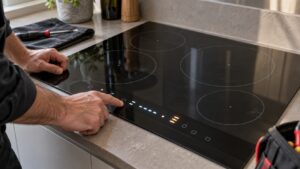
These dacor induction cooktop tips apply to the Contemporary and Transitional induction lineup — models like the DTI36M977BB and DTI30M977BB — which runs Dacor’s fully documented nine-code information table, confirmed directly from the Modernist Induction Cooktop User Manual.
Cookware: what induction actually needs
Induction cooking only works with cookware that a magnet sticks to — cast iron and most stainless steel qualify, while aluminum, copper, and glass cookware without a magnetic base will not heat at all, regardless of how the zone is set. A zone that seems entirely dead with one pan may work perfectly with another, and checking cookware compatibility before assuming a zone has failed rules out the single most common false alarm on this platform.
Cleaning the frameless glass surface without damaging it
The frameless black-glass surface on Dacor’s current induction cooktops runs edge to edge with no metal trim ring, which looks clean but means the glass itself is doing all the work of resisting scratches. Abrasive pads or gritty cleaners will dull the surface over time; a dedicated ceramic-cooktop cleaner and a soft cloth, applied after the surface has cooled, protect the finish far better. Wiping spills before they bake on also reduces the chance residue interferes with the sensor readings underneath the glass.
Reading the nine-code table correctly
C0 and C1 both concern the top sensor — open or shorted, respectively — while C2 flags the IGBT sensor. F0, F1, and F2 point to communication failures between the main and sub PCB, the EEPROM, and the touch-enabled IC. A2 flags the cooling fan motor specifically, not the cooking surface itself. UP means incoming voltage sits outside the expected 208 to 240 volt range, which is a household electrical issue rather than a cooktop problem. The one code worth understanding before assuming anything electronic has failed is d0: a key registered as pressed for more than eight seconds, most often from a wet or dirty touch panel rather than a genuine control failure.
What does not apply to this platform
Some aggregator sites list F0, F1, and F2 for an unspecified “Heritage” electric cooktop with meanings copied word-for-word from the Classic wall oven problem table. No dedicated Legacy-era cooktop service document was found to confirm these, and the current induction platform’s own F0/F1/F2 codes — the communication problems above — have entirely different meanings from that unverified Legacy list. Do not cross-reference the two tables.
When to book service
A repeated C0 or C1 sensor failure, an A2 fan failure that does not clear, or a zone that will not heat with confirmed induction-compatible cookware are worth bringing to an experienced technician. We work independently of Dacor and Samsung, and our labor is covered for 30 days. Our cooktop error codes page lists the full nine-code table, and scheduling a visit with the exact code noted speeds up diagnosis. Dacor’s own site lists current induction cooktop models and finishes.