
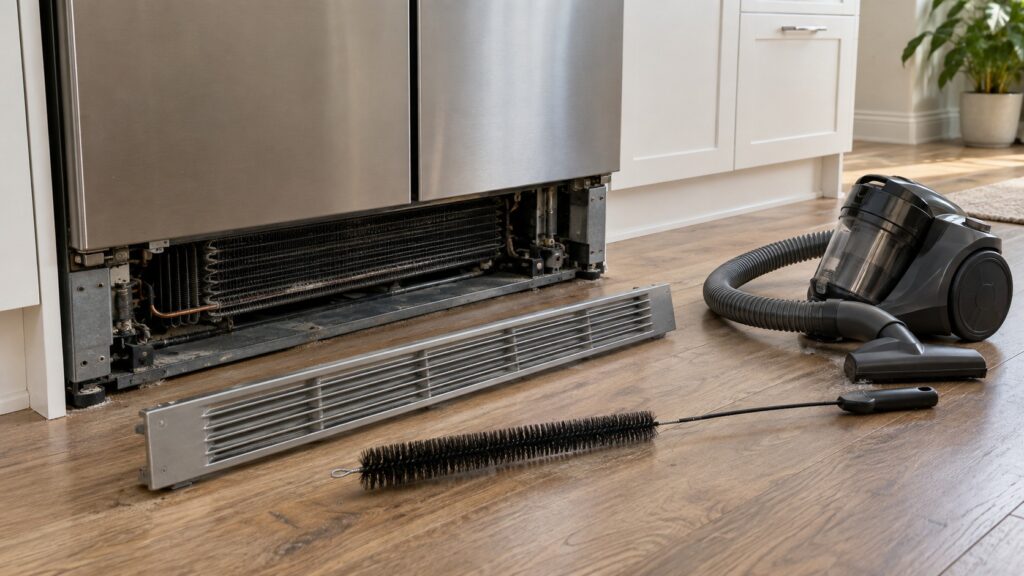
TL;DR: Clean the condenser coils on a Dacor refrigerator once or twice a year. Switch the unit off at the breaker, remove the lower grille or rear access panel your manual describes, vacuum the dust from the coils and fan with a soft brush attachment, and put everything back before restoring power. Dusty coils make the compressor run longer, raise the cabinet temperature and shorten the life of the cooling system.
The condenser coils are where a refrigerator gets rid of the heat it removes from your food. If they are coated in dust and pet hair, that heat cannot escape, and the compressor has to run longer to do the same job. For a built-in refrigerator surrounded by custom cabinetry, which is how most Dacor units are installed, the problem is worse, because there is little room for air. Dacor refrigerator condenser coil cleaning takes about twenty minutes and is one of the most useful jobs on the maintenance list. This guide shows where the coils are, how to clean them safely, and what the signs of neglect look like.
Where are the condenser coils on a Dacor refrigerator?
The location depends on the model. On many refrigerators, including built-in French door and column units, the coils sit low at the front or the rear of the cabinet, behind a removable grille or a rear access panel, beside the compressor and a small fan. Some units place the coils behind a panel at the back that is reached only by pulling the unit forward, which on a built-in refrigerator is not a job to attempt casually. Check your use and care manual for the access point on your model, and look at the rating plate to be sure which model you have.
Dacor refrigerators on this site include models such as the DRF36C500SR and DRF365300AP, and column units such as the DRR36980RAP. The principle is the same across them: find the grille, remove it according to the manual, and you will see the coils and fan.
How do I clean the coils step by step?
Begin with safety. Switch the refrigerator off at the breaker, because the fan and compressor sit right beside the coils. Take out any food that you cannot leave for an hour in a closed refrigerator, although a short job will not warm it much. Remove the lower grille by following your manual, which may involve clips or a few screws, and use a flashlight to look at the coils.
Use the vacuum with a soft brush attachment to take the loose dust off the grille, the coils and the floor beneath the unit. Then slide a long, narrow coil brush between the coils, moving along the direction of the fins, to pull out dust that has packed deeper in. Clean around the fan blades and the compressor, but do not push on wires or bend the fins. Wipe the grille, put it back and restore power. The whole job takes about twenty minutes.
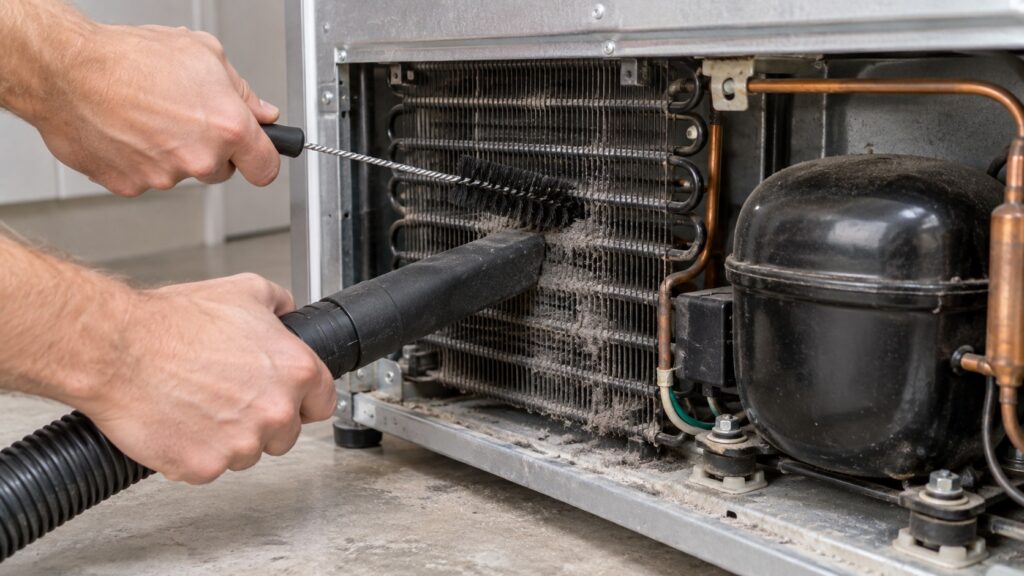
When the power comes back, the compressor and fans will start within a few minutes, and the cabinet will take several hours to settle. Do not judge the result right away. If you cleaned a heavily clogged condenser, you may notice the compressor sounding different or running in shorter cycles, which is a sign that it is working more easily.
What are the signs that the coils need cleaning?
The coils tell you in two ways. First, the refrigerator works harder: the compressor runs for long periods or seems never to stop, the cabinet does not reach the set temperature and the sides or base feel warm. Our symptom pages for the compressor running constantly and not cooling to the set temperature list the causes in order, and dirty coils are on both. Second, the connected alarms may trigger: a Dacor refrigerator can send a temperature notification to your phone when it cannot hold its setpoint. See the abnormally high temperature alarm guide for what that means.
Dirty coils are one cause among several. A door that does not seal, a heavy load of warm food or a refrigerator with no space to breathe can produce the same symptoms. If the coils are clean and the problem remains, check the gasket and the clearance around the unit, and then call for service. A failing fan or compressor is a technician’s job.
Does a built-in refrigerator need extra room to breathe?
Yes. A built-in refrigerator relies on air moving through the grille and around the cabinet, and a panel, a cabinet or a stored item that blocks that path traps the heat. Keep the grille clear of boxes, mats and cleaning supplies. Make sure no one has added trim or insulation across the vent opening. If the unit is panel ready, check that the panel does not cover the grille or the vent slots, which the installation sheet shows. Our guide to how Dacor PreciseCooling works explains why stable airflow matters for holding temperature.
The drain pan near the coils is also worth a glance while you are there. Water standing in it, or a pan that is cracked, points to a drain problem rather than a coil problem; our guide to the Dacor refrigerator ice maker water line covers the water side.
What else belongs on the refrigerator maintenance list?
The coils are part of a routine: replace the water filter on schedule, clean the door gaskets, keep the vents inside the cabinet clear and check the temperature setting. The full list is in the Dacor refrigerator maintenance schedule, and column units have their own checklist in the column refrigeration maintenance guide. If the refrigerator is old and keeps struggling after cleaning, weigh the options in repair or replace a Dacor refrigerator. To have the cooling system tested, see Dacor refrigerator repair or schedule a visit.