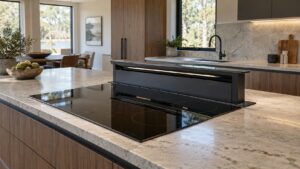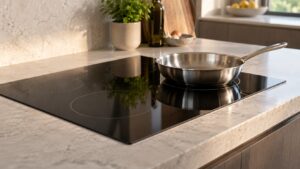
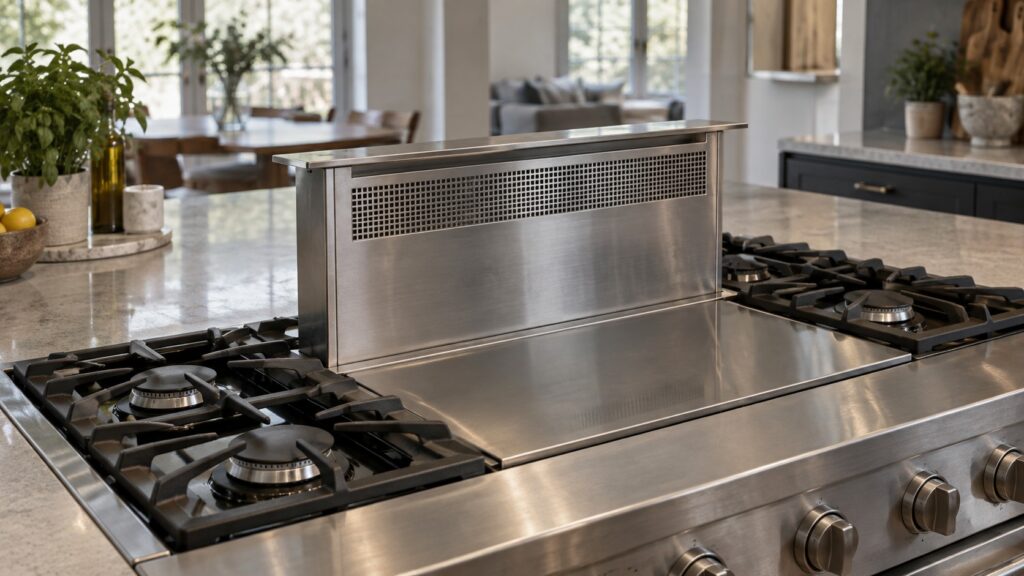
A Dacor cooktop downdraft vent is a ventilation system built into or behind the cooktop itself, pulling smoke, steam, and grease-laden air down and out through ductwork below the floor or behind the wall, instead of up through a hood mounted overhead. It exists specifically for kitchens where an island or a peninsula cooktop has no ceiling above it to hang a range hood from, and for kitchens where the owner does not want a hood blocking the sightline across an open floor plan. On Dacor’s lineup, a downdraft vent is not a separate accessory you add later — it is either built into the specific cooktop or rangetop model, or it is not an option for that unit at all.
What does a Dacor downdraft vent actually do?
The vent contains a low-profile fan and a duct connection, usually routed down through the cabinet base and out through the floor joists or an exterior wall. When it is running, it creates enough airflow across the cooktop surface to carry cooking byproducts away from the burners and down into the duct before they rise and spread across the room. It is a physically different approach from an overhead hood, which captures the plume after it has already risen a foot or two above the pan. A downdraft system has to work harder against a rising column of hot air, which is why the fan motors on these units tend to run louder or draw more power than an equivalent overhead hood for the same coverage.
Which Dacor cooktops and rangetops include one?
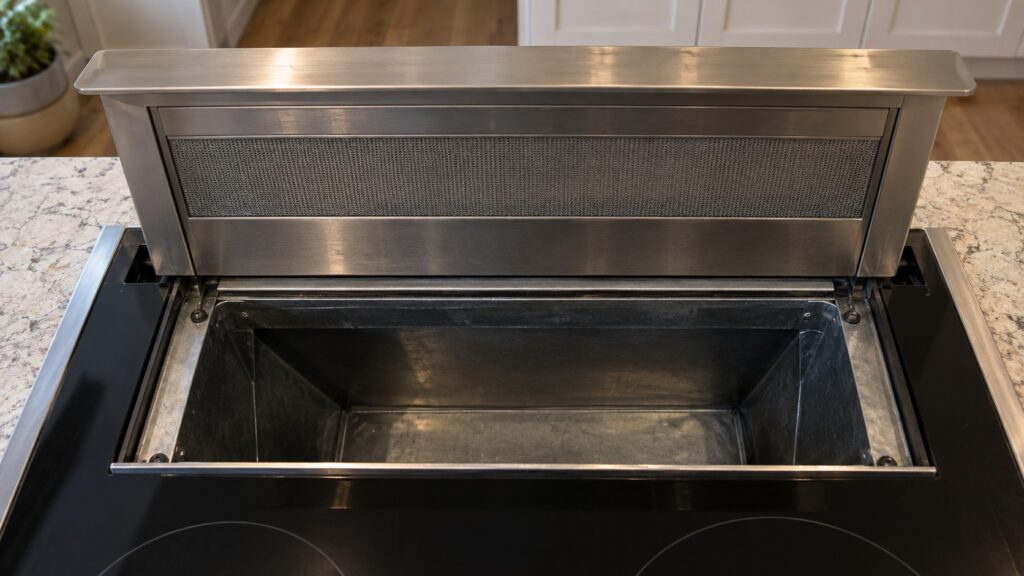
Not every Dacor cooktop has a downdraft option, and it is not something that can be retrofitted onto a model that was not built for it — the vent housing, the retraction mechanism, and the duct connection are part of the cooktop’s own construction. Some Dacor rangetop models built for island installations include a retractable downdraft vent that rises a few inches above the deck when switched on and drops flush when idle; other cooktop models in the lineup are designed to work with an overhead hood only and have no downdraft hardware at all. Before assuming a specific cooktop can be paired with downdraft ventilation, check that model’s own spec sheet — the feature is model-specific, not a lineup-wide option you can add on request.
How is a downdraft vent different from a range hood?
Both systems move air out of the kitchen, and both use similar-sized blowers, but the airflow direction is the real difference. A range hood sits above the cooking surface and pulls the rising plume up and out, which works well for tall pots and high-heat searing where a lot of steam rises quickly. A downdraft vent sits at or near cooktop level and pulls air sideways and down, which works better for flatter cookware and lower, spread-out heat, but is less effective against a tall pot of boiling pasta where steam rises well above the vent’s reach before it can be captured. Kitchens with an island cooktop often choose downdraft specifically because there is nowhere to mount a hood; kitchens with wall placement more often default to a hood because it captures a wider range of cooking styles.
What goes wrong with a downdraft vent over time?
The moving parts are the retraction mechanism and the blower motor, and both see more mechanical cycling than a fixed overhead hood does. A vent that will not rise, will not retract, or rises only partway is almost always a mechanical or motor problem rather than an electronics fault, and it is covered in detail in our Dacor downdraft vent won’t raise guide if that is the symptom you are seeing. Weak suction with the vent raised and running normally is a different problem — usually a duct restriction, a clogged grease filter at the vent inlet, or a blower losing speed — and is closer to what a range hood airflow complaint looks like on the overhead side.
Which fuel types pair with a downdraft vent?
Downdraft ventilation shows up on both gas and induction cooktop models, and the fuel type does not change how the vent itself works — it changes what the vent is dealing with. A gas downdraft installation has to account for the flame’s own upward draft working against the vent’s pull, which is one reason downdraft systems on gas cooktops sometimes need a stronger blower than an equivalent electric or induction installation to achieve the same clearing performance. An induction cooktop produces no open flame and comparatively little rising heat, so a downdraft vent on an induction model is working mainly against steam and cooking odors rather than against combustion byproducts, and tends to feel more effective at a given fan speed than the same vent would on a gas burner.
Does a downdraft vent need its own maintenance routine?
Yes, in the same way a range hood does: the filter at the vent inlet collects grease and needs periodic cleaning, and the duct run underneath needs to stay clear of kinks, especially where it turns to go down through a cabinet base rather than straight out through a wall. Because the ductwork on a downdraft system usually runs a longer, more convoluted path than an overhead hood’s short vertical run to the roof or wall, restriction tends to build up gradually rather than announcing itself all at once — a slow drop in how quickly the kitchen clears of smoke over a few months is a more common sign than a sudden failure.
If you have a Dacor cooktop or rangetop with a downdraft vent and are not sure whether the ventilation problem is the fan, the duct, or the retraction mechanism, our technicians can identify which one it is before ordering a part. We are an independent repair company, not a factory service arm, and pricing starts from a diagnostic visit with the estimate confirmed before any work begins. See our Dacor cooktop buying guide if you are shopping for a model, schedule Dacor cooktop repair for an existing unit, or book a visit directly if an existing downdraft vent needs attention.