Dacor cooktop C0 means the top sensor has been read open, so the control can no longer confirm the temperature of the glass surface. C1 is the mirror image of it — the same sensor read as a short. C2 is a different sensor altogether: the one watching the IGBT, the power electronics that drive the induction coils. Three codes, two separate circuits, and the distinction decides whether a technician arrives expecting a sensor and a harness or a power module.
What does C0 mean on a Dacor cooktop?
An induction cooktop does not heat the glass on purpose — it heats the pan, and the glass gets warm because the pan is sitting on it. The surface sensor exists to keep that incidental heat inside safe limits: an empty pan left on a zone, a boil-dry, or a pan with a warped base that traps heat in one spot. When the control reads that sensor as open, it has no number to work with, and it refuses to run rather than run blind.
Open readings usually come from a break rather than from the sensing element itself. A connector that has vibrated loose, a lead pinched during a countertop installation, or a harness rubbing on a cabinet edge will all read the same way to the board. That is why the code page for this fault lists the harness beside the sensor: see Dacor Cooktop C0 for the components involved.
Is C1 a different fault from C0?
Same sensor, opposite electrical failure. Open means the circuit is broken and no current flows where the board expects it. Shorted means current flows where it should be limited. The diagnosis differs less than the words suggest, because a technician measures the same circuit either way, but the likely causes split: an open reading points toward a connector or a broken lead, while a short more often points toward damaged insulation where two conductors touch or moisture bridging a connector.
Moisture is worth naming. A cooktop that has had a pan boil over, and has then been wiped down enthusiastically around the control area, can produce a short reading that dries out and disappears. If C1 turns up once after a spill and never again, that is what happened. If it turns up every time the cooktop reaches working temperature, it is a fault.
Why is C2 about the electronics and not the glass?
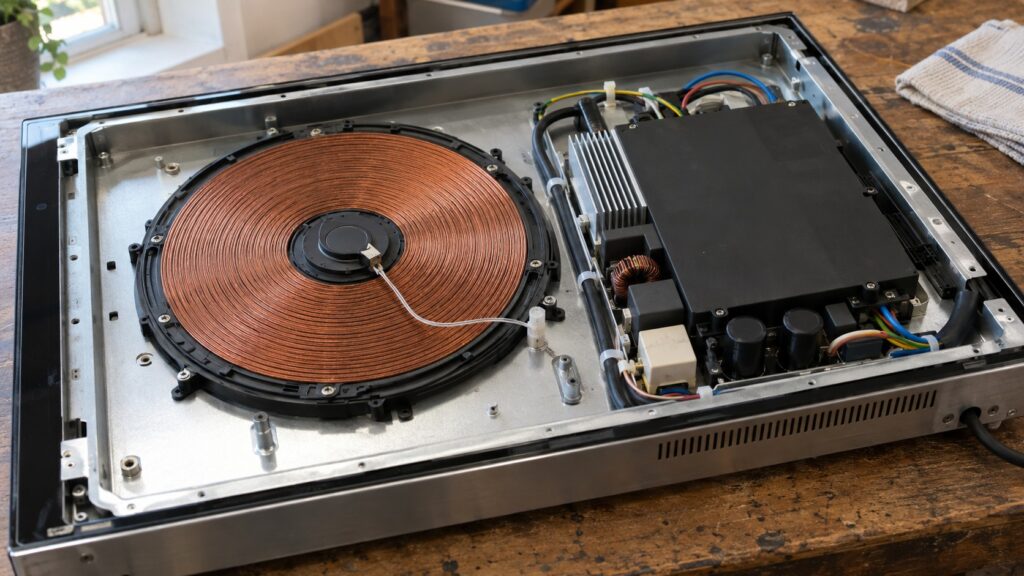
Under the glass, each cooking zone has a coil, and each coil is driven by a power module built around IGBTs — the switching devices that turn the incoming supply into the high-frequency field the pan absorbs. Those devices produce heat of their own and are cooled by a fan. The IGBT sensor watches that, not the cooking surface.
So C2 and C0 describe two different risks. C0 is about the glass and what is standing on it. C2 is about the electronics compartment below — its fan, its airflow, and whether anything has blocked the vents. This matters for a household with a downdraft or a deep drawer immediately beneath the cooktop, where the space is tighter than the installation drawing assumed.
Which code table applies to my cooktop?
These three belong to the Samsung-era induction cooktops. The same range of models produces other letters for entirely different problems, and mixing the tables sends people to the wrong part. F0, F1 and F2 on this cooktop are communication failures between boards, set out in the communication code guide. A2 and UP are the cooling fan and the incoming voltage, compared in A2 versus UP. None of those is a temperature sensor, and none of the three codes on this page is a communication fault.
If your cooktop is radiant rather than induction, the hardware under the glass is different and so is the reasoning. The difference is set out in induction versus radiant.
What can I check before booking service?
There is a short owner-side list, and it stops at the glass.
Let it cool completely. A cooktop that has been running hard, especially with a large pan covering two zones, may simply be protecting itself. Give it half an hour with nothing on it.
Clear the vents. Whatever sits below and beside the cooktop needs the clearance the installation called for. A storage drawer repacked with baking sheets standing on edge can close off the path air takes to the electronics.
Dry the control area. After a boil-over, wipe and then leave the cooktop off for an hour before trying again.
Power cycle once. Off at the breaker for a minute, then back on. Note whether the code returns immediately or only under load.
Do not lift the glass. The coils, the power modules and their capacitors are underneath, and the glass is bonded to a frame that is not meant to come apart in a kitchen. This is the point to stop.
When does this become a board job?
Call when a code returns after cooling and a power cycle, when more than one zone refuses, when the cooktop restarts and fails again within minutes, or when C2 appears on a cooktop installed above a drawer or a downdraft. A technician measures the sensor circuits cold and warm, checks continuity through the harness, and only then looks at the main PCB. Ordering a board first is the most common way to spend money on this fault and still have it.
Everyday habits that keep these circuits healthy — pan sizes, spills, and what not to leave on a warm zone — are collected in induction cooktop tips.
We are an independent repair company and not a factory service arm. Pricing starts from a diagnostic visit and we confirm the estimate before any work begins. Dacor cooktop repair covers sensors, harnesses, power modules and controls, and you can schedule a visit online.