If your Dacor downdraft fails repair or replace is the decision, and it comes down to what actually failed. A vent that will not rise is a lift problem: a motor, a drive gear, a limit switch, a wiring harness or something stuck in the slot. Those are repairable parts on a cooktop that is otherwise sound, so repair is usually the first thing to price. Replacement enters the picture when the cooktop itself is failing in other ways, when the part cannot be sourced, or when the ventilation was never working for your kitchen. The downdraft is built into the cooktop, so you cannot swap the vent alone for a different one.
What does a Dacor downdraft do, and why does it fail?
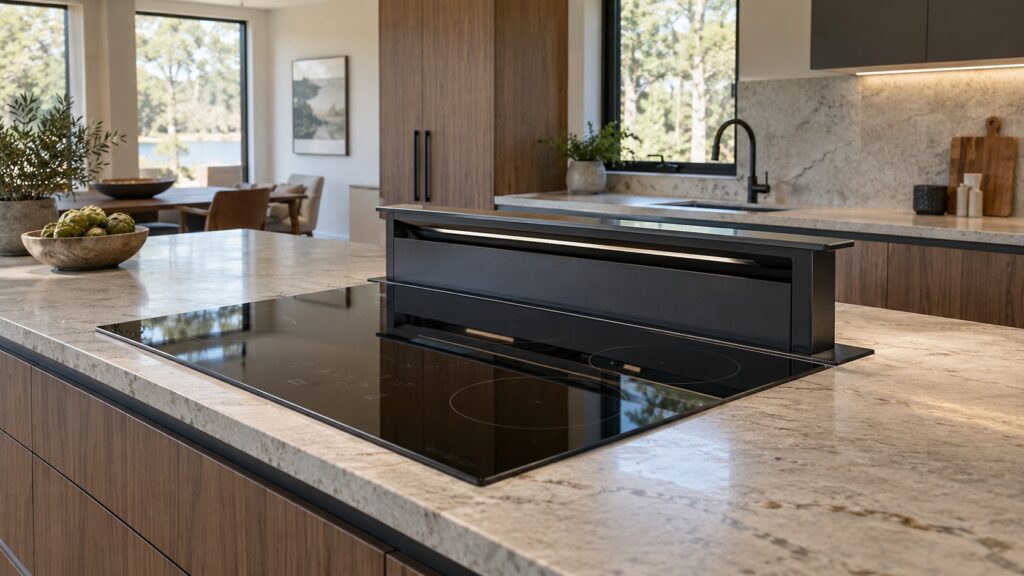
A Dacor downdraft vent pulls smoke and steam down through ducting below the cooktop instead of up into a hood. Our glossary explains that it is not an accessory you add later: it is either built into the specific cooktop or rangetop, or it is not an option for that unit. It is meant for island and peninsula kitchens with nothing overhead to hang a hood from. The moving parts are the retraction mechanism and the blower motor, and both see more mechanical cycling than a fixed overhead hood. Our Dacor cooktop downdraft vent glossary covers the design in full.
Because the vent is part of the cooktop, a failed vent is a decision about the whole unit: fix the part, or replace a cooktop that also contains a perfectly good cooking surface.
Which downdraft failures are worth repairing?
Most of them, because the failure is usually in a short list of parts rather than in the cooktop. Our page on a downdraft vent that will not raise says a vent that stays down is a lift problem and the fault is almost always among the motor, the drive gear, the limit switch and the harness, not the blower. The sound tells you which: a motor that hums without moving is usually loaded, a motor that runs while nothing happens points to a stripped gear, silence means no power or a limit switch, and a vent that stops halfway has generally hit an obstruction.
The obstruction case is the one an owner can often fix. Anything that lands in the slot behind the cooking surface rides up with the vent, and grease dried in the guides stiffens the travel. With the cooktop and the vent switched off at the breaker and everything cool, look down the slot with a flashlight. If something is lying loose and can be lifted out without pushing a hand or a tool into the slot, take it out, and wipe only the part of the travel path you can see. If anything is wedged, or you would have to reach in, stop and book a technician. If clearing the slot fixes it, there is nothing to decide.
When does replacement make more sense?
Three situations favor replacing the cooktop. The first is that the cooktop has other problems, such as a cracked glass surface, an unresponsive control or burners that no longer light, so you would be repairing one part of an aging unit. The second is that a genuine part is not available for your model, which a technician can tell you after identifying it; we do not know the availability of any particular part from our pages. The third is that the vent never cleared your kitchen well in the first place. Our glossary notes that a downdraft works harder against a rising column of hot air than an overhead hood does, and does less well against tall pots of boiling water. If weak ventilation has always been the complaint, repairing the lift will not change that.
If you are weighing a replacement, check the spec sheet of the new model for downdraft hardware before you order, since our pages say not every Dacor cooktop has the option. Our cooktop buying guide for induction and gas helps with the choice of fuel.
Is the problem the vent lift or the airflow?
Separate the two before you decide anything, because they are different repairs. A vent that rises and pulls weakly is a blower-side or filter-side question: grease filters at the vent inlet, a stuck damper, or a duct that is restricted or longer than the design allows. Our glossary says a slow drop in how quickly the kitchen clears of smoke over a few months is a more common sign than a sudden failure. Cleaning the filter is an owner task; the duct under the cabinet is not.
The hood-side logic is similar, and our guide to range hood repair or replace when the blower fails shows how the decision usually turns on one component and on the cost of reaching it. Dacor ventilation has no fault codes, which our page on range hoods without error codes explains, so the behavior you describe is the diagnosis.
What should you not do yourself?
Stop after the slot and the filters. Do not pull the cooktop out of the counter and do not remove the housing. Our troubleshooting page warns that the lift assembly sits in a cabinet shared with a gas line or a cooktop supply on most installations, and that the vent body is heavy enough to injure fingers if it releases unexpectedly. Gas lines and wiring are for a qualified professional. If you smell gas, do not switch anything on or off, leave the house and call your gas utility or 911 from outside. If you see sparks or smell burning, switch off the breaker at the panel while standing on a dry floor.
How do you make the call?
Ask a technician to identify what failed, then compare three things: whether the failed part is on the short lift list, whether the rest of the cooktop is in good order, and whether a repair costs far less than a new cooktop plus its installation and any cabinet or duct work. A part swap is usually far cheaper than a new unit when the cooktop is otherwise sound, and it avoids touching the countertop cutout. Our general guide, repair or replace a Dacor appliance, gives the wider framework, and the Dacor cooktop repair page explains what a diagnostic visit covers.