
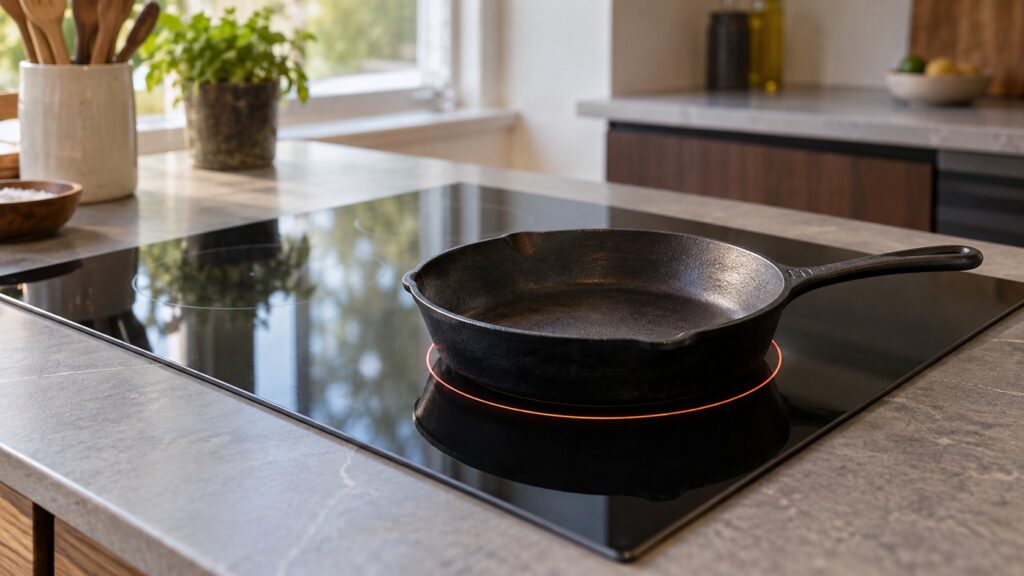
TL;DR: A Dacor induction cooktop heats the pan itself, not the glass. Under each zone sits a coil that creates a rapidly changing magnetic field; in a magnetic pan base that field produces heat directly. A sensor watches the glass, power electronics switch the coil, a fan cools the electronics and a touch panel runs it all. Each of those parts has its own code when it fails.
People ask how Dacor induction cooktops work for practical reasons: why the glass stays cooler than a pan, why a pot is ignored when it is not magnetic, why a fan starts up underneath, and what the codes mean when something stops. Understanding the chain of parts makes every one of those questions easier. This guide follows the path from the plug to the pan, in the order that energy travels, and shows where the codes on the Samsung-era Modernist induction models listed on this site belong in that chain, including the DTI36P876BB, DTI30M977BB and DTI36M977BB.
How does an induction cooktop heat a pan without heating the glass?
Under each cooking zone is a flat coil of copper wire. The electronics send high-frequency alternating current through it, which creates a magnetic field that reverses direction tens of thousands of times a second. When a pan with a magnetic base sits on the zone, that changing field drives electrical currents through the metal of the base, and the resistance of the metal turns them into heat. The pan becomes the heater.
The glass is not heated by the coil. It warms only because the hot pan sits on it, so after you lift the pan the glass cools much faster than a radiant element would. That is also why the surface can still be warm to the touch after cooking, which is why the cooktop shows a residual-heat indicator. The chain from coil to pan depends on three things: a magnetic base, good contact and the right power at the right moment.
Why does an induction zone ignore some pans?
Because without a magnetic base there is nothing for the field to heat. Aluminum, copper and glass cookware do not work, and some stainless pans lack a magnetic layer in the base. The cooktop does not report a fault; it simply keeps the zone inactive, because the circuit can tell that no suitable load is present. A pan that is too small for the zone, warped or placed off the marked circle can also fail to couple properly. A magnet that sticks firmly to the underside is the quickest test.
This is normal behavior, not a malfunction, and it is the most common reason an induction cooktop owner calls for help. Our pan not detected page lists the causes, and the Dacor induction cooktop tips cover cookware and daily use.
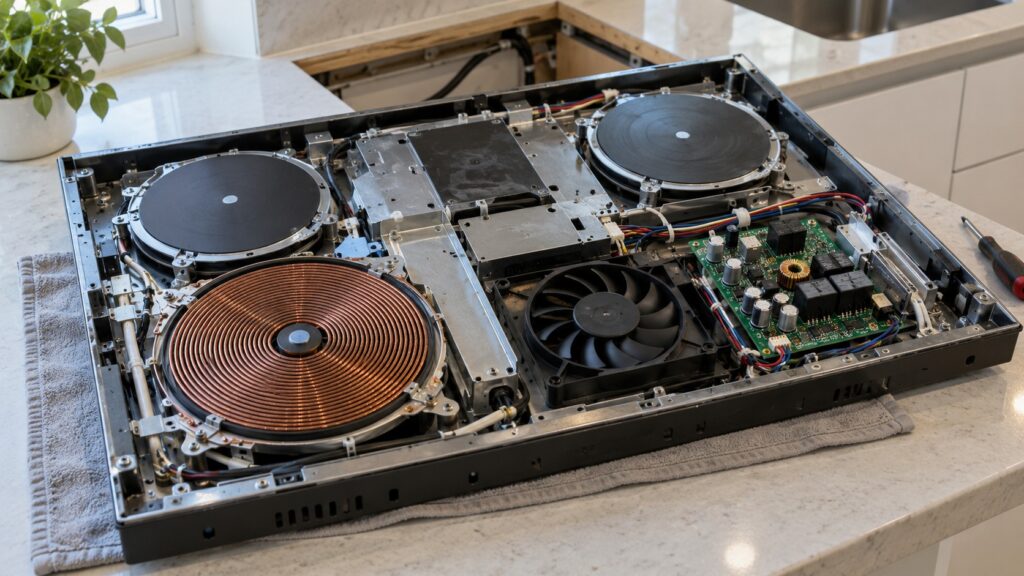
What do the sensor and the fan do?
Induction electronics make heat of their own, and glass can be damaged if a zone runs away. Two protections handle that. The top sensor reports glass temperature to the main board, which cuts power to the zone if the reading climbs too far or cannot be trusted. On the Dacor Modernist cooktops covered here, C0 means the main board reads that sensor line as open and C1 means it reads shorted; either way the zone is disabled rather than allowed to heat blind. C2 flags an open sensor on the IGBT circuit that protects the power switches. The three are explained in our Dacor cooktop C0, C1 and C2 guide.
The fan is the second protection. Its job is to pull air across the coil modules and power electronics so they stay within a safe range, especially at high power. If the fan is blocked, wired badly or driven by a failed circuit, the board raises A2. Dust or grease near the fan intake makes it labor, and a long run at maximum power makes it work harder. Our guide to the A2 fan code and the UP voltage code separates the fan from the supply.
How does the touch panel talk to the rest?
The touch panel is a layer of sensors on the glass that tells the sub board where your finger is. The sub board passes your request to the main board, which runs the zones. When that chain breaks, the cooktop reports a communication failure: F0 for the link between the main and sub boards, F1 for the stored settings memory, and F2 for the touch-enabled chip. A related code, d0, appears when a key is pressed or held for too long, which is why a spill or a cloth resting on the controls can set it off. See the F0, F1 and F2 communication guide for the detail.
That architecture explains some odd behavior. A zone that stops mid-cook with no code is usually a protective pause from overheating, for example after an empty pan on a high setting. Repeated beeping with no code is typically a timer left unacknowledged or moisture on the panel. And a dark, unresponsive cooktop is usually a supply problem upstream, not a coil, as we describe in how to turn on a Dacor cooktop.
Is induction the right choice for my kitchen?
Induction responds quickly, controls low heat well and is easy to wipe clean, but it needs compatible cookware and a proper 240-volt circuit. If you are weighing it against gas or radiant, read the induction versus gas buying guide and the induction versus radiant glossary. For problems the codes do not cover, see Dacor cooktop repair or schedule a visit.